
|
Legal & Tax Disclosure
ATTORNEY ADVERTISING.
This article is provided for general informational purposes only and does not constitute legal, financial, or tax advice. Reading this content does not create an attorney-client or professional advisory relationship. Laws vary by jurisdiction and are subject to change. You should consult a qualified professional regarding your specific circumstances. |
Glenn stared at the amended Trust, a cold dread settling in his stomach. He’d painstakingly updated everything after his retirement, intending to provide for his children from a previous marriage. But his wife, Emily, had discovered the codicil—the one removing her as a beneficiary—and the ensuing argument had cost him thousands in legal fees already. He thought he was protecting his kids, but now faced the very real possibility of a protracted and expensive court battle.
As an estate planning attorney and CPA with over 35 years of experience here in Escondido, California, I’ve seen this scenario play out countless times. The short answer is yes, it is generally legal to disinherit your spouse. California is a community property state, but that doesn’t prevent you from leaving your separate property to whomever you choose, including excluding your spouse. However, it’s rarely that simple. There are significant hurdles, and a poorly drafted will or trust can be easily challenged.
What are the Common Reasons for Disinheritance?
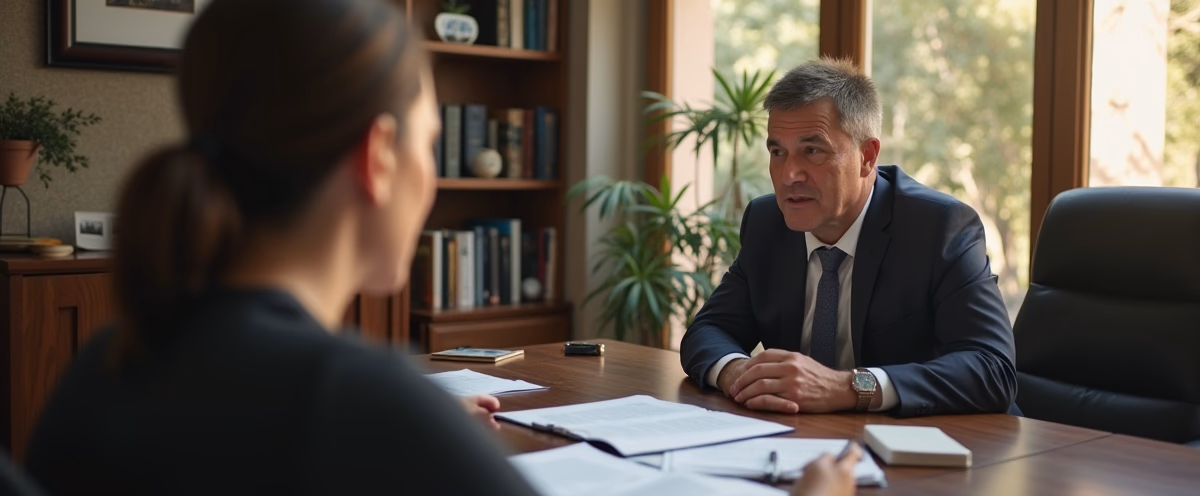
Spouses disinherit each other for a variety of reasons, often stemming from complex family dynamics or a change in circumstances. Some common motivations include:
-
Estrangement: If the marriage has deteriorated, and there is a clear and documented history of separation or conflict, a spouse may choose to exclude the other from their estate.
Remarriage Plans: Anticipating a future remarriage, someone might want to ensure assets pass to children or other family members.
Prior Commitments: A prenuptial or postnuptial agreement may dictate specific asset distribution that differs from standard community property laws.
Substance Abuse or Financial Mismanagement: Concerns about a spouse’s ability to responsibly manage an inheritance can lead to disinheritance.
What are the Risks of Disinheritance?
California law offers certain protections to spouses, even when excluded from a will or trust. A spouse can file a claim for a share of the community property, and may even be able to challenge the validity of the disinheritance.
-
Community Property Rights: California operates under community property rules. Assets acquired during the marriage are generally owned equally by both spouses. A spouse can claim half of all community property regardless of what the will states.
Statutory Share: Even with separate property, a spouse might be entitled to a statutory share of the estate, particularly if the disinheritance leaves them without adequate means of support.
Will Contests: A spouse can challenge a will or trust based on allegations of undue influence, lack of capacity, or fraud.
How Can I Maximize the Chance of a Successful Disinheritance?
Minimizing the risk of a successful challenge requires meticulous planning and proper documentation. As a CPA as well as an attorney, I bring a unique perspective to these matters, particularly concerning valuation and step-up in basis. Properly valuing assets and understanding capital gains implications is critical.
-
Separate Property Identification: Clearly identify and document all separate property assets. This includes property owned before the marriage, gifts received during the marriage, and inheritances received individually.
Detailed Reasoning: Include a detailed explanation in your will or trust outlining the reasons for the disinheritance. While not legally required, it can be persuasive to a court.
Independent Counsel: Have your spouse consult with their own attorney. This demonstrates transparency and reduces the potential for claims of undue influence.
Regular Review: Update your estate plan regularly to reflect changes in your assets, family circumstances, and California law.
Moreover, remember that as of January 1, 2026, non-exempt LLCs must comply with FinCEN’s Beneficial Ownership Information (BOI) reporting; executors and beneficiaries managing inherited entities must file updated reports within 30 days of ownership changes to avoid significant civil penalties.
What Happens if My Spouse Challenges the Will?
If a spouse does challenge your will or trust, the case will proceed through probate court. The court will examine the evidence and determine the validity of the disinheritance. A judge may consider factors such as the length of the marriage, the spouse’s financial needs, and any evidence of undue influence. Assets without valid beneficiaries may trigger probate if the total value of personal property exceeds $208,850 (for deaths occurring on or after April 1, 2025); a Will alone does not bypass this limit.
Ultimately, proactive estate planning, coupled with careful documentation and a thorough understanding of California law, is the best defense against a successful challenge. I’ve dedicated over 35 years to helping clients navigate these complex issues and ensure their wishes are honored.
Understanding this specific rule is helpful, but it is ultimately the strength of your underlying Will that protects your legacy.
Too often, families resolve one specific issue but leave their broader estate vulnerable to litigation due to poor Will drafting.
Understanding the following standards is critical to ensuring your wishes are honored in probate court:
What makes a California will legally enforceable when it matters most?
In California, a last will and testament operates within a probate system that emphasizes intent, clarity, and procedural compliance. When properly drafted, a will does more than distribute property—it creates legally enforceable instructions that guide courts, fiduciaries, and beneficiaries through administration with fewer disputes and less uncertainty.
- Clarity: Avoid vague terms that trigger probate disputes.
- Incapacity: verify mental state at signing.
- Errors: check for missing amendments often.
For California residents, understanding how intent, authority, and compliance interact is one of the most effective ways to protect family harmony and estate integrity. A will that anticipates probate scrutiny is far more likely to be honored as written and far less likely to become the source of unnecessary conflict.
Official Resources for Probate, Legal Standards, and Tax Rules
-
Probate / Beneficiaries:
San Diego Superior Court – Probate Division:
Provides essential Escondido-specific “Local Rules” (Division IV) and forms effective January 1, 2026, including Rule 4.4.5 for remote appearances, mandatory e-filing protocols for Escondido County, and the calendar for the Central Courthouse. -
Legal Standards:
State Bar of California:
The official regulatory agency for California’s 270,000+ attorneys; use this portal to verify a lawyer’s license status, check for a history of disciplinary actions, and access the 2026 guidelines for ethical attorney-client fee agreements. -
Tax / Estate Tax:
IRS Estate Tax Guidelines:
The authoritative federal resource for estate and gift tax filing; this page reflects the 2026 “OBBBA” permanent exemption of $15 million per individual, which replaced the scheduled 2026 “tax cliff” from previous legislation. -
Self-Help / Forms:
California Courts – Wills, Estates, and Probate:
The Judicial Council’s primary self-help center offering standardized forms for 2026, including the updated $208,850 “Small Estate Affidavit” and the $750,000 “Primary Residence” simplified transfer procedure (AB 2016).
|
Attorney Advertising, Legal Disclosure & Authorship
ATTORNEY ADVERTISING.
This content is provided for general informational and educational purposes only and does not constitute legal, financial, or tax advice. Under the California Rules of Professional Conduct and State Bar advertising regulations, this material may be considered attorney advertising. Reading this content does not create an attorney-client relationship or any professional advisory relationship. Laws vary by jurisdiction and are subject to change, including recent 2026 developments under California’s AB 2016 and evolving federal estate and reporting requirements. You should consult a qualified attorney or advisor regarding your specific circumstances before taking action.
Responsible Attorney:
Steven F. Bliss, California Attorney (Bar No. 147856).
Local Office:
Escondido Probate Law720 N Broadway 107 Escondido, CA 92025 (760) 884-4044
Escondido Probate Law is a practice location and trade name used by Steven F. Bliss, Esq., a California-licensed attorney.
About the Author & Legal Review Process
This article was researched and drafted by the Legal Editorial Team of the Law Firm of Steven F. Bliss, Esq.,
a collective of attorneys, legal writers, and paralegals dedicated to translating complex legal concepts into clear, accurate guidance.
Legal Review:
This content was reviewed and approved by Steven F. Bliss, a California-licensed attorney (Bar No. 147856). Mr. Bliss concentrates his practice in estate planning and estate administration, advising clients on proactive planning strategies and representing fiduciaries in probate and trust administration proceedings when formal court involvement becomes necessary.
With more than 35 years of experience in California estate planning and estate administration,
Mr. Bliss focuses on structuring enforceable estate plans, guiding fiduciaries through court-supervised proceedings, resolving creditor and notice issues, and coordinating asset management to support compliant, timely distributions and reduce fiduciary risk. |