
|
Legal & Tax Disclosure
ATTORNEY ADVERTISING.
This article is provided for general informational purposes only and does not constitute legal, financial, or tax advice. Reading this content does not create an attorney-client or professional advisory relationship. Laws vary by jurisdiction and are subject to change. You should consult a qualified professional regarding your specific circumstances. |
It started with a frantic call from Emily. Her mother, Joan, had passed unexpectedly, and Emily, named as executor, couldn’t access Joan’s iCloud account. Joan hadn’t left a note with passwords, and Emily, understandably, assumed she could simply request access. She’d tried all likely passwords, security questions, and two-factor authentication codes, to no avail. The problem? Joan’s digital estate was significant – years of photos, financial records, and critical insurance information were locked behind Apple’s security protocols. This seemingly small issue quickly escalated, costing Emily weeks of legal fees and emotional distress just to obtain a court order compelling Apple to cooperate, an expense easily exceeding $5,000.
The core issue isn’t malice or Apple’s inflexibility; it’s the Revised Uniform Fiduciary Access to Digital Assets Act (RUFADAA), which has fundamentally changed how executors access digital property. Before RUFADAA, access often depended on Terms of Service agreements, which generally prioritized user privacy above all else. Now, while RUFADAA aims to provide a legal framework, it’s surprisingly nuanced and requires explicit written direction. Per the Revised Uniform Fiduciary Access to Digital Assets Act (RUFADAA), custodians like Apple or Google are legally prohibited from granting executors access to the content of emails or private messages without ‘explicit written direction’ in the will or trust. Metadata (the ‘catalog’) may be accessible, but the private content remains locked without this specific legal trigger.
What does “explicit written direction” mean? It’s not enough to state “my executor will have access to all my digital assets.” The will or trust must specifically identify the digital assets and authorize access. Even more problematic, the direction must comply with the custodian’s terms of service. For example, Apple requires a specific form acknowledging their policies, regardless of what the will states. Without that form, even a court order may be insufficient. This is where a seasoned estate planning attorney, coupled with a CPA’s understanding of asset valuation, becomes invaluable.
This brings us to the broader issue of digital asset valuation and potential tax implications. Many people underestimate the value of their digital holdings. Cryptocurrency, online businesses, domain names, even valuable gaming accounts, can all represent significant assets. As a CPA for over 35 years, I’ve seen countless estates tripped up by failing to properly account for these holdings. The step-up in basis rules apply to digital assets just like traditional property, but identifying and valuing them requires specialized knowledge. Neglecting to do so can result in unnecessary capital gains taxes. The proper valuation also impacts the executor’s fiduciary duty; they are legally obligated to maximize the value of the estate.
Beyond valuation, consider the potential for fraud or unauthorized access. If an executor can’t secure a digital account, it’s vulnerable to hackers and identity theft. Conversely, simply granting broad access without proper safeguards can open the estate to litigation. That’s why a comprehensive digital asset plan is critical, outlining not just what assets exist, but who has access, how they access them, and when access is granted. For example, a trust can be structured to provide staggered access, granting limited access to the successor trustee initially, with full access only after a specific waiting period or upon the completion of certain conditions.
Furthermore, the Corporate Transparency Act (CTA) adds another layer of complexity. Under the Corporate Transparency Act (CTA), all non-exempt small businesses must maintain active BOI Reports with FinCEN. Upon the death of a member, the estate or successor has exactly 30 days from the date the estate is settled to file an updated report; failure to meet this window triggers non-waivable fines of $500 per day. This applies even if the business is a single-member LLC, and the digital assets are used to run the business.
Finally, let’s not forget about incapacity planning. What happens if you become incapacitated before you can execute a digital asset plan? Under both federal HIPAA and the California Confidentiality of Medical Information Act (CMIA), medical providers are strictly barred from sharing details with family unless a HIPAA Release is integrated into the Advance Healthcare Directive. Without this, a spouse may be forced to obtain an emergency court-ordered conservatorship just to speak with a surgeon.
In short, the days of simply knowing a password are over. A robust digital asset plan, drafted by an attorney familiar with RUFADAA, combined with a CPA’s expertise in valuation and tax implications, is essential to protect your digital estate and ensure a smooth transition for your loved ones.
While addressing this specific concern is vital, your entire estate plan relies on the enforceability of your Last Will and Testament.
Too often, families resolve one specific issue but leave their broader estate vulnerable to litigation due to poor Will drafting.
Understanding the following standards is critical to ensuring your wishes are honored in probate court:
What standards do California judges use to determine a will’s true meaning?
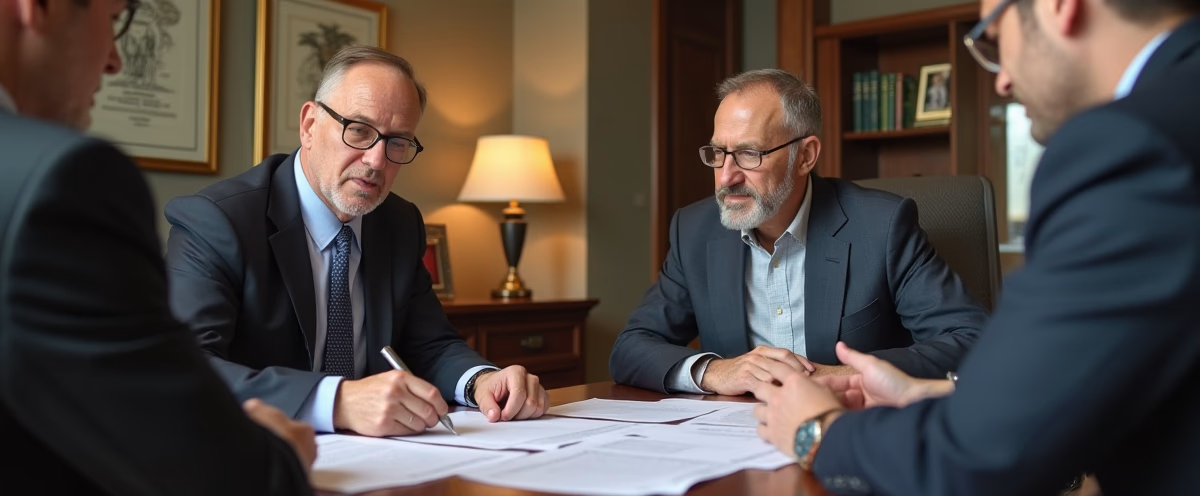
In California, a last will and testament operates within a probate system that emphasizes intent, clarity, and procedural compliance. When properly drafted, a will does more than distribute property—it creates legally enforceable instructions that guide courts, fiduciaries, and beneficiaries through administration with fewer disputes and less uncertainty.
| End Game | Consideration |
|---|---|
| Tax Impact | Address debts and taxes. |
| Transfer | Manage assets. |
| Heirs | Protect beneficiaries. |
When a will is drafted with California probate review in mind, it becomes a stabilizing roadmap rather than a source of conflict. Clear intent, proper authority, and compliant execution protect both families and estates.
Controlling Legal Standards Governing California Estate and Asset Transfers
-
Probate & Court Procedure:
California Courts – Wills, Estates, and Probate
The official judicial branch guide for navigating the probate process; it provides updated 2026 checklists for determining if an estate qualifies for “Summary Probate” under the $208,850 personal property limit or the $750,000 primary residence threshold (AB 2016). -
Property Tax Reassessment (Prop 19):
California State Board of Equalization (Prop 19)
The definitive resource for understanding the “Parent-to-Child” reassessment exclusion; it outlines the strict one-year deadline for heirs to move into an inherited home as their primary residence to maintain the parent’s low property tax base. -
Advance Healthcare Planning:
California Attorney General – Advance Health Care Directive
Provides the official California statutory form and legal guidelines for appointing a health care agent; this resource emphasizes the necessity of combining a medical power of attorney with a HIPAA release to ensure doctors can communicate with family during an emergency. -
Federal Estate & Gift Tax:
IRS Estate Tax Guidelines
The authoritative federal portal for estate and gift tax reporting; this page reflects the 2026 “OBBBA” permanent exemption of $15 million per person, effectively replacing the previously scheduled Tax Cuts and Jobs Act (TCJA) sunset. -
Digital Asset Access (RUFADAA):
California RUFADAA Law (Probate Code §§ 870-884)
Access the full statutory text of the Revised Uniform Fiduciary Access to Digital Assets Act; it explains why executors are legally barred from accessing encrypted accounts, email, or crypto-wallets unless the decedent provided explicit “prior consent” in their estate plan.
|
Attorney Advertising, Legal Disclosure & Authorship
ATTORNEY ADVERTISING.
This content is provided for general informational and educational purposes only and does not constitute legal, financial, or tax advice. Under the California Rules of Professional Conduct and State Bar advertising regulations, this material may be considered attorney advertising. Reading this content does not create an attorney-client relationship or any professional advisory relationship. Laws vary by jurisdiction and are subject to change, including recent 2026 developments under California’s AB 2016 and evolving federal estate and reporting requirements. You should consult a qualified attorney or advisor regarding your specific circumstances before taking action.
Responsible Attorney:
Steven F. Bliss, California Attorney (Bar No. 147856).
Local Office:
Escondido Probate Law720 N Broadway 107 Escondido, CA 92025 (760) 884-4044
Escondido Probate Law is a practice location and trade name used by Steven F. Bliss, Esq., a California-licensed attorney.
About the Author & Legal Review Process
This article was researched and drafted by the Legal Editorial Team of the Law Firm of Steven F. Bliss, Esq.,
a collective of attorneys, legal writers, and paralegals dedicated to translating complex legal concepts into clear, accurate guidance.
Legal Review:
This content was reviewed and approved by Steven F. Bliss, a California-licensed attorney (Bar No. 147856). Mr. Bliss concentrates his practice in estate planning and estate administration, advising clients on proactive planning strategies and representing fiduciaries in probate and trust administration proceedings when formal court involvement becomes necessary.
With more than 35 years of experience in California estate planning and estate administration,
Mr. Bliss focuses on structuring enforceable estate plans, guiding fiduciaries through court-supervised proceedings, resolving creditor and notice issues, and coordinating asset management to support compliant, timely distributions and reduce fiduciary risk. |