|
Legal & Tax Disclosure
ATTORNEY ADVERTISING.
This article is provided for general informational purposes only and does not constitute legal, financial, or tax advice. Reading this content does not create an attorney-client or professional advisory relationship. Laws vary by jurisdiction and are subject to change. You should consult a qualified professional regarding your specific circumstances. |
Emily just called, absolutely devastated. Her handwritten Will, meticulously crafted over years, was deemed invalid because she didn’t have the required witnesses present when she signed it. Years of planning, gone, because of a technicality. The estate is now facing a protracted and expensive probate battle, and her family is understandably distraught. This isn’t an isolated incident; I’ve seen it happen far too many times, costing families significant time, money, and emotional stress.
As an Estate Planning Attorney and CPA with over 35 years of experience here in Escondido, I often encounter clients who attempt to create their own Wills. While technically permissible in California, doing so presents substantial risks that many don’t fully appreciate. It’s not simply about stating who gets your assets; it’s about ensuring your wishes are legally enforceable and minimize potential headaches for your loved ones. The perceived “savings” of a DIY Will are often dwarfed by the costs of litigating a flawed document.
What are the Requirements for a Valid Handwritten Will in California?
Many people assume they can simply write out their wishes on a piece of paper and it will be legally binding. This is true only if you meet very specific requirements. California allows for “holographic” Wills – those entirely written in your own handwriting – but they must be entirely handwritten; no typed or pre-printed portions are permitted. More importantly, the entire document must express your testamentary intent – meaning it must be clear you’re intending to distribute your property after your death. A grocery list with a casual mention of leaving something to a friend won’t cut it.
However, even a perfectly handwritten Will is susceptible to challenge. A common issue arises when clients believe they can add a “codicil” (an amendment) to an existing Will with a simple handwritten note. While a codicil can be validly added, it too must meet the same strict handwritten requirements as the original Will and be signed and witnessed according to the standard rules. This is where I see clients like Emily fall into trouble.
What Witnesses Are Required, and What Happens if I Don’t Have Them?
California law requires two disinterested witnesses to be present at the signing of your Will. These witnesses must see you sign the document, and they must sign themselves in your presence. California Probate Code § 6112 dictates that an ‘interested witness’ (a beneficiary) triggers a legal presumption of duress or fraud. Unless there are two other disinterested witnesses, the beneficiary may lose their gift, taking only what they would have received under intestacy rules.
If you fail to have proper witnesses, or if a witness is deemed “interested,” the Will may be invalidated. If a Will is invalidated, assets fall under intestacy; however, for deaths on or after April 1, 2025, estates with personal property under $208,850 (per CPC § 13100) may still bypass full probate via affidavit. But even this “small estate” process can be complicated and is far from ideal.
What About Mistakes in the Document Itself?
Even if your Will is properly signed and witnessed, errors in the language can create significant problems. Vague or ambiguous wording can lead to disputes among beneficiaries, forcing a court to interpret your intentions. Probate Code § 6110(c)(2) allows the court to validate a signature-defective Will if there is ‘clear and convincing evidence’ of the testator’s intent; however, this requires a costly court petition and is not a guaranteed safety net.
As a CPA as well as an attorney, I also emphasize the importance of tax planning. Properly drafted Wills and Trusts can minimize estate taxes and maximize the “step-up in basis” for inherited assets, potentially saving your beneficiaries a substantial amount in capital gains taxes. This nuance is often missed in DIY Wills, resulting in unnecessary tax burdens.
How Can I Ensure My Will is Valid and Enforceable?
The best way to protect your loved ones and ensure your wishes are carried out is to consult with a qualified Estate Planning Attorney. While there’s an upfront cost, it’s a small price to pay for peace of mind. We can help you navigate the complex legal requirements, draft a comprehensive document tailored to your specific needs, and ensure it’s properly executed. Probate Code § 8220 states that including a self-proving affidavit allows the Will to be admitted to probate without the testimony of the subscribing witnesses, significantly accelerating the court’s approval process.
While California allowed temporary remote witnessing during the pandemic, the law (CPC § 6110) has reverted to requiring strict simultaneous presence; remote signatures are generally invalid for Wills unless they meet the narrow ‘Electronic Will’ standards of AB 298. Furthermore, if you own digital assets, RUFADAA 2.0 (SB 1458) – effective 2025, California law (CPC § 871) was expanded to grant fiduciaries power over digital accounts; however, you must still grant explicit RUFADAA powers in your Will or Trust to bypass federal privacy blocks.
While addressing this specific concern is vital, your entire estate plan relies on the enforceability of your Last Will and Testament.
Too often, families resolve one specific issue but leave their broader estate vulnerable to litigation due to poor Will drafting.
Here is how California courts evaluate the true intent and validity of your estate documents:
How do California courts decide whether a will reflects true intent or creates ambiguity?
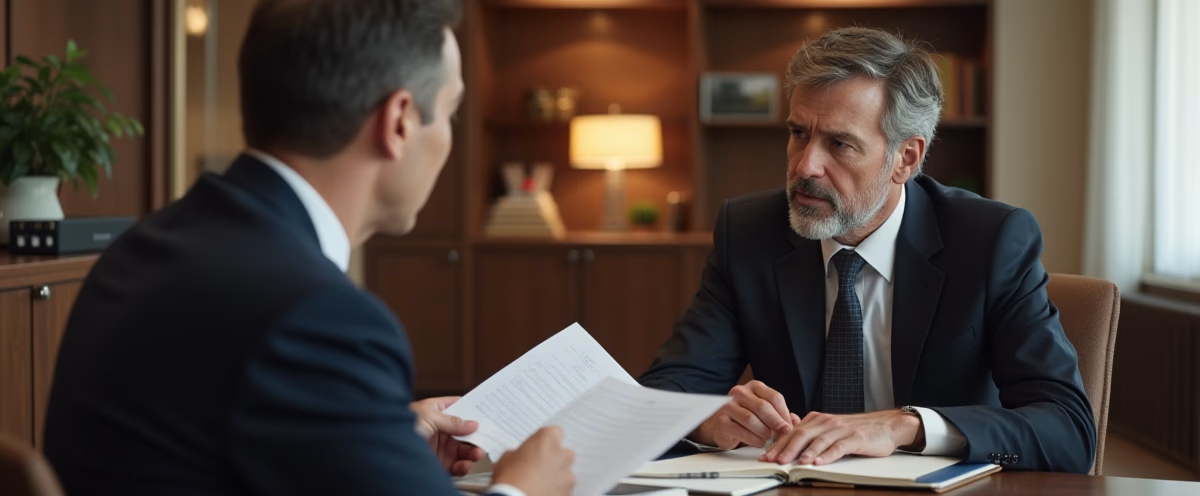
In California, a last will and testament is reviewed under probate standards that focus on intent, capacity, and execution. Clear drafting reduces ambiguity, limits misinterpretation, and helps families avoid unnecessary conflict during estate administration.
| Core Focus | Impact |
|---|---|
| Clear Wishes | Clear intent reduces judicial guesswork. |
| Compliance | Compliance shields the will from technical challenges. |
| Authority | Proper designation prevents power struggles. |
When a will is drafted with California probate review in mind, it becomes a stabilizing roadmap rather than a source of conflict. Clear intent, proper authority, and compliant execution protect both families and estates.
Resources for Legal Standards & Probate Procedure
-
Escondido Local Rules: San Diego Superior Court – Probate Division
Access the essential “Local Rules” (Division IV) effective January 1, 2026. This includes mandatory e-filing procedures, current Probate Examiner notes, and Local Rule 4.4.5 regarding remote appearance requirements (via MS Teams) for non-evidentiary hearings. -
Attorney Verification: State Bar of California
The official regulatory body for California attorneys. Use this to verify a lawyer’s “Certified Specialist” status in Estate Planning or to access 2026 guidelines on the ethical handling of Client Trust Accounts (IOLTA). -
Self-Help & Forms: California Courts – Wills, Estates, and Probate
The Judicial Council’s official portal. It includes the updated 2026 forms for the $208,850 personal property threshold and the $750,000 “Primary Residence” simplified transfer procedure (AB 2016). -
Federal Estate Tax: IRS Estate Tax Guidelines
The authoritative federal resource for estate and gift tax filing. It reflects the 2026 “OBBBA” permanent exemption of $15 million per individual, replacing the previously scheduled Tax Cuts and Jobs Act (TCJA) sunset.
|
Attorney Advertising, Legal Disclosure & Authorship
ATTORNEY ADVERTISING.
This content is provided for general informational and educational purposes only and does not constitute legal, financial, or tax advice. Under the California Rules of Professional Conduct and State Bar advertising regulations, this material may be considered attorney advertising. Reading this content does not create an attorney-client relationship or any professional advisory relationship. Laws vary by jurisdiction and are subject to change, including recent 2026 developments under California’s AB 2016 and evolving federal estate and reporting requirements. You should consult a qualified attorney or advisor regarding your specific circumstances before taking action.
Responsible Attorney:
Steven F. Bliss, California Attorney (Bar No. 147856).
Local Office:
Escondido Probate Law720 N Broadway 107 Escondido, CA 92025 (760) 884-4044
Escondido Probate Law is a practice location and trade name used by Steven F. Bliss, Esq., a California-licensed attorney.
About the Author & Legal Review Process
This article was researched and drafted by the Legal Editorial Team of the Law Firm of Steven F. Bliss, Esq.,
a collective of attorneys, legal writers, and paralegals dedicated to translating complex legal concepts into clear, accurate guidance.
Legal Review:
This content was reviewed and approved by Steven F. Bliss, a California-licensed attorney (Bar No. 147856). Mr. Bliss concentrates his practice in estate planning and estate administration, advising clients on proactive planning strategies and representing fiduciaries in probate and trust administration proceedings when formal court involvement becomes necessary.
With more than 35 years of experience in California estate planning and estate administration,
Mr. Bliss focuses on structuring enforceable estate plans, guiding fiduciaries through court-supervised proceedings, resolving creditor and notice issues, and coordinating asset management to support compliant, timely distributions and reduce fiduciary risk. |