|
Legal & Tax Disclosure
ATTORNEY ADVERTISING.
This article is provided for general informational purposes only and does not constitute legal, financial, or tax advice. Reading this content does not create an attorney-client or professional advisory relationship. Laws vary by jurisdiction and are subject to change. You should consult a qualified professional regarding your specific circumstances. |
Emily stared at the probate notice, a knot tightening in her stomach. Her estranged uncle, a man she hadn’t spoken to in over twenty years, had left her his beachfront property in Malibu. It sounded incredible, a life-changing gift. But the property came with a crumbling house, a mountain of back taxes, and a complicated history with local preservation groups. Accepting it felt…impossible. She’d called me, Steve Bliss, an estate planning attorney and CPA in Escondido, California, fearing a legal trap, thinking she had to take whatever her uncle left behind. Her anxiety wasn’t unusual – many clients, after 35+ years in practice, are overwhelmed by inheritances that aren’t the windfall they appear to be.
The short answer is yes, a beneficiary can absolutely refuse an inheritance. It’s a concept known as disclaiming the inheritance. But it’s not as simple as just saying “no thank you.” There are strict rules and potential tax implications.
What Does it Mean to Disclaim an Inheritance?
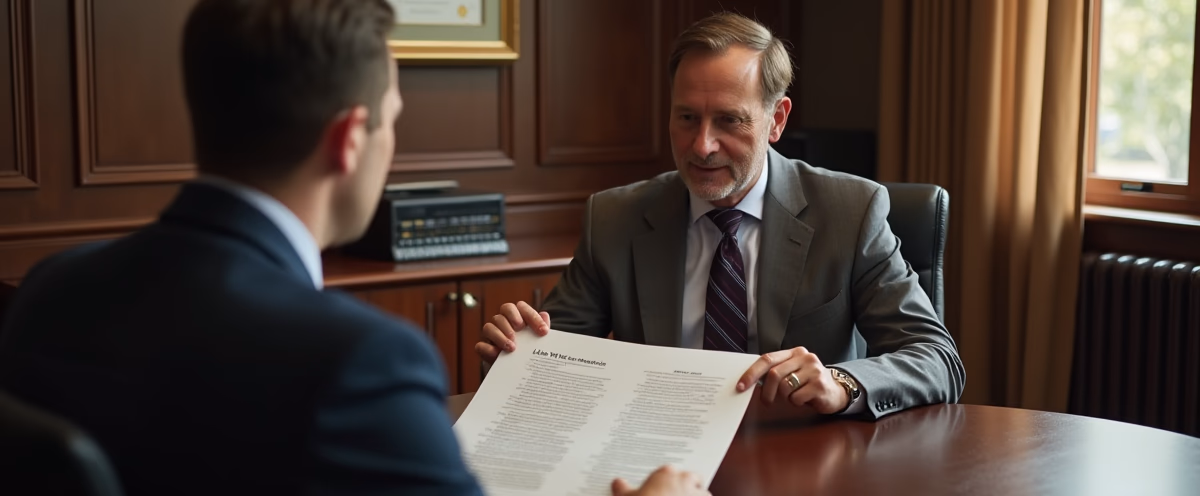
A disclaimer is a legally binding statement where a beneficiary formally declines to accept assets from an estate. The key is timing. It must be made within a specific period, generally nine months from the date of the decedent’s death, and before any attempt to take possession of the property. Attempting to take any benefit from the estate – living in the house, collecting rent, even starting renovations – generally invalidates the disclaimer. Further, the beneficiary must not have done anything that appears to show acceptance of the inheritance.
What Happens to the Assets if Disclaimed?
When an inheritance is disclaimed, it passes to the contingent beneficiaries named in the Will. If there’s no contingent beneficiary, or they’ve also disclaimed, the assets will be distributed according to California’s intestate succession laws – essentially, as if the decedent had no Will. This could mean the property goes to other family members, even those your uncle hadn’t intended to receive it. It’s crucial to understand the full ripple effect.
Why Would Someone Disclaim an Inheritance?
There are several legitimate reasons. Emily’s situation is a prime example. Large debts attached to the property, potential liabilities, or complex legal issues can make accepting an inheritance more trouble than it’s worth. Another common reason is tax implications. While inheritances themselves aren’t typically taxable income, the inherited asset becomes taxable to the beneficiary. Receiving property with a low cost basis could trigger significant capital gains taxes upon sale. As a CPA, I often advise clients to consider disclaiming assets if the step-up in basis wouldn’t provide a meaningful tax benefit. For instance, if the property’s value is close to its original purchase price, there may be little advantage to inheriting it versus having it pass to someone in a lower tax bracket.
Disclaiming Assets and Government Benefits
Perhaps more critically, accepting an inheritance can jeopardize government benefits. Effective January 1, 2026, California has reinstated asset limits ($130,000 for individuals) for non-MAGI Medi-Cal programs, meaning an inheritance could immediately disqualify a beneficiary from aged or disabled aid. Disclaiming the inheritance can protect eligibility.
What About Digital Assets and LLCs?
The complexities extend beyond traditional property. Under California’s RUFADAA (Probate Code § 870), beneficiaries and executors are legally barred from accessing digital accounts, photos, and crypto-wallets unless the decedent explicitly granted authority in their Will, Trust, or via an ‘online tool’. Similarly, if the estate includes a Limited Liability Company (LLC), be very careful. As of January 1, 2026, non-exempt LLCs must comply with FinCEN’s Beneficial Ownership Information (BOI) reporting; executors and beneficiaries managing inherited entities must file updated reports within 30 days of ownership changes to avoid significant civil penalties.
Small Estate Considerations and the Importance of a Will
Don’t assume a small inheritance is automatically safe to refuse without considering probate rules. Assets without valid beneficiaries may trigger probate if the total value of personal property exceeds $208,850 (for deaths occurring on or after April 1, 2025); a Will alone does not bypass this limit. For deaths on or after April 1, 2025, a primary residence worth $750,000 or less (gross value) may qualify for a simplified transfer under AB 2016 (Probate Code § 13151), bypassing formal probate.
Ultimately, disclaiming an inheritance is a complex legal decision. I always advise clients to seek counsel before taking any action, ensuring they fully understand the consequences and potential alternatives.
Understanding this specific rule is helpful, but it is ultimately the strength of your underlying Will that protects your legacy.
Too often, families resolve one specific issue but leave their broader estate vulnerable to litigation due to poor Will drafting.
To protect your family from unnecessary conflict, you must understand how judges evaluate the enforceability of your Will:
How do probate courts in California evaluate intent when a will is challenged?
In California, a last will and testament is reviewed under probate standards that focus on intent, capacity, and execution. Clear drafting reduces ambiguity, limits misinterpretation, and helps families avoid unnecessary conflict during estate administration.
For California residents, understanding how intent, authority, and compliance interact is one of the most effective ways to protect family harmony and estate integrity. A will that anticipates probate scrutiny is far more likely to be honored as written and far less likely to become the source of unnecessary conflict.
Official Resources for Probate, Legal Standards, and Tax Rules
-
Probate / Beneficiaries:
San Diego Superior Court – Probate Division:
Provides essential Escondido-specific “Local Rules” (Division IV) and forms effective January 1, 2026, including Rule 4.4.5 for remote appearances, mandatory e-filing protocols for Escondido County, and the calendar for the Central Courthouse. -
Legal Standards:
State Bar of California:
The official regulatory agency for California’s 270,000+ attorneys; use this portal to verify a lawyer’s license status, check for a history of disciplinary actions, and access the 2026 guidelines for ethical attorney-client fee agreements. -
Tax / Estate Tax:
IRS Estate Tax Guidelines:
The authoritative federal resource for estate and gift tax filing; this page reflects the 2026 “OBBBA” permanent exemption of $15 million per individual, which replaced the scheduled 2026 “tax cliff” from previous legislation. -
Self-Help / Forms:
California Courts – Wills, Estates, and Probate:
The Judicial Council’s primary self-help center offering standardized forms for 2026, including the updated $208,850 “Small Estate Affidavit” and the $750,000 “Primary Residence” simplified transfer procedure (AB 2016).
|
Attorney Advertising, Legal Disclosure & Authorship
ATTORNEY ADVERTISING.
This content is provided for general informational and educational purposes only and does not constitute legal, financial, or tax advice. Under the California Rules of Professional Conduct and State Bar advertising regulations, this material may be considered attorney advertising. Reading this content does not create an attorney-client relationship or any professional advisory relationship. Laws vary by jurisdiction and are subject to change, including recent 2026 developments under California’s AB 2016 and evolving federal estate and reporting requirements. You should consult a qualified attorney or advisor regarding your specific circumstances before taking action.
Responsible Attorney:
Steven F. Bliss, California Attorney (Bar No. 147856).
Local Office:
Escondido Probate Law720 N Broadway 107 Escondido, CA 92025 (760) 884-4044
Escondido Probate Law is a practice location and trade name used by Steven F. Bliss, Esq., a California-licensed attorney.
About the Author & Legal Review Process
This article was researched and drafted by the Legal Editorial Team of the Law Firm of Steven F. Bliss, Esq.,
a collective of attorneys, legal writers, and paralegals dedicated to translating complex legal concepts into clear, accurate guidance.
Legal Review:
This content was reviewed and approved by Steven F. Bliss, a California-licensed attorney (Bar No. 147856). Mr. Bliss concentrates his practice in estate planning and estate administration, advising clients on proactive planning strategies and representing fiduciaries in probate and trust administration proceedings when formal court involvement becomes necessary.
With more than 35 years of experience in California estate planning and estate administration,
Mr. Bliss focuses on structuring enforceable estate plans, guiding fiduciaries through court-supervised proceedings, resolving creditor and notice issues, and coordinating asset management to support compliant, timely distributions and reduce fiduciary risk. |