|
Legal & Tax Disclosure
ATTORNEY ADVERTISING.
This article is provided for general informational purposes only and does not constitute legal, financial, or tax advice. Reading this content does not create an attorney-client or professional advisory relationship. Laws vary by jurisdiction and are subject to change. You should consult a qualified professional regarding your specific circumstances. |
Glenn came into my office last week, utterly distraught. His wife, Emily, had filed for divorce, and he’d just discovered she’d unilaterally removed him as a beneficiary from her $1.2 million retirement account. He’d been listed for over 20 years, assuming his designation was secure. He was shocked to learn it wasn’t, and the potential loss of those funds was devastating. His story isn’t uncommon; divorce proceedings often trigger unintended consequences regarding estate planning documents, and simply getting divorced isn’t enough to guarantee your removal from someone’s Will or trust.
Here in California, divorce has a complex interplay with estate planning. While a divorce will legally terminate your marriage, it doesn’t automatically revoke beneficiary designations on accounts like retirement plans, life insurance policies, or even real estate deeds. This is a critical point many people misunderstand. It’s a common misconception that once the divorce is finalized, all previous designations are voided. That’s simply not true.
The legal doctrine at play is the concept of ‘revocation on divorce.’ California Family Code section 2200.5 specifically addresses this. Generally, a divorce does revoke provisions in a Will or Trust that leave property to the former spouse. However, this revocation is not automatic. You must take affirmative action to update your estate plan, or the designation can remain valid. This is especially important with retirement accounts.
What Happens to Retirement Accounts in a Divorce?
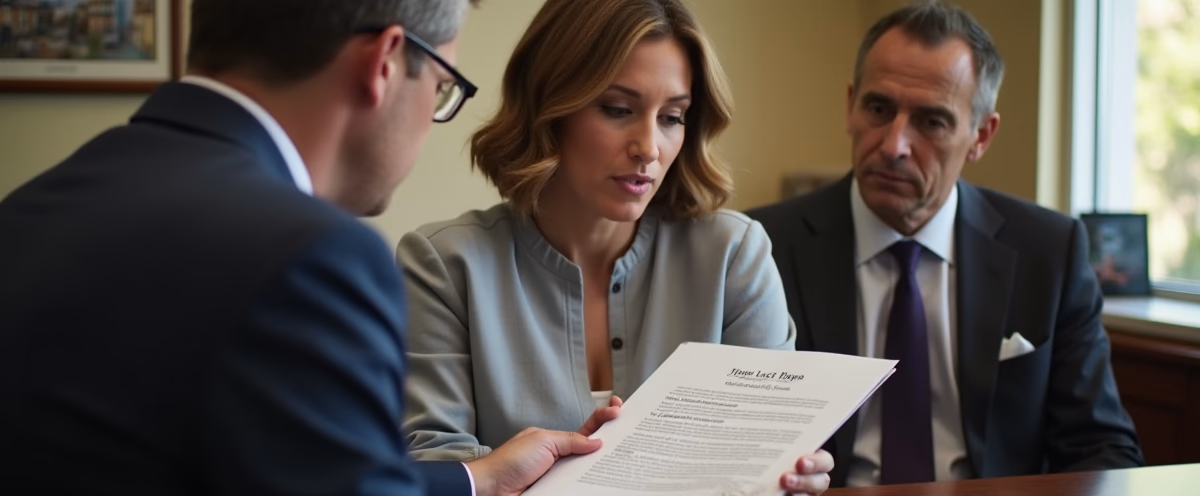
Retirement accounts are often the biggest asset in a marriage, and their division during divorce can be complicated. Under California’s community property laws, assets acquired during the marriage are typically divided equally. But a Qualified Domestic Relations Order (QDRO) is usually required to actually transfer funds from one spouse’s retirement account to the other. Even after a QDRO is issued, the original beneficiary designation on the account often remains unchanged. Emily’s retirement plan administrator didn’t automatically update the beneficiary based on the divorce decree; they required a separate, specific request to remove Glenn.
What About Real Estate and Other Assets?
Real estate is another area where divorce doesn’t automatically rewrite ownership. A divorce decree will specify how the property is divided, but it doesn’t automatically change the title of the property. A separate deed needs to be prepared and recorded to reflect the new ownership arrangement. Similarly, life insurance policies, brokerage accounts, and other assets require updated beneficiary designations. Failing to do so can result in unintended consequences, like Glenn’s situation. As of April 1, 2025, a primary residence worth $750,000 or less (gross value) may qualify for a simplified transfer under AB 2016 (Probate Code § 13151), bypassing formal probate.
Digital Assets and the Importance of Planning
Don’t forget about digital assets – your online accounts, photos, crypto wallets, and other electronic holdings. These assets are increasingly valuable, and often aren’t addressed in traditional estate planning. Accessing these accounts after a divorce or death can be incredibly difficult if there isn’t a clear designation of authority. Under California’s RUFADAA (Probate Code § 870), beneficiaries and executors are legally barred from accessing digital accounts, photos, and crypto-wallets unless the decedent explicitly granted authority in their Will, Trust, or via an ‘online tool’.
Why a CPA-Attorney is Crucial
With over 35 years of experience as both an Estate Planning Attorney and a CPA, I see firsthand how critical it is to understand the tax implications of asset division during divorce. For example, the ‘step-up in basis’ is often overlooked. Properly structuring the division of assets can minimize capital gains taxes down the line. A qualified CPA can also help with asset valuation, ensuring a fair and equitable split. The increased complexity of FinCEN reporting for business assets means oversight from an experienced advisor is essential. As of January 1, 2026, non-exempt LLCs must comply with FinCEN’s Beneficial Ownership Information (BOI) reporting; executors and beneficiaries managing inherited entities must file updated reports within 30 days of ownership changes to avoid significant civil penalties.
In Glenn’s case, we’re working to legally compel Emily’s plan administrator to remove him as beneficiary and secure his rightful portion of the divorce settlement. It’s a fight he might have avoided with proactive estate planning. Don’t wait for a crisis to take action. Reviewing and updating your estate plan after a divorce is essential to protect your future and ensure your wishes are honored.
While addressing this specific concern is vital, your entire estate plan relies on the enforceability of your Last Will and Testament.
As a dual-licensed CPA and Attorney, I warn clients that specific asset strategies are useless if the core Will fails to meet probate standards.
Understanding the following standards is critical to ensuring your wishes are honored in probate court:
What does a California probate court look for when interpreting testamentary intent?
In California, a last will and testament is reviewed under probate standards that focus on intent, capacity, and execution. Clear drafting reduces ambiguity, limits misinterpretation, and helps families avoid unnecessary conflict during estate administration.
| Issue | Prevention |
|---|---|
| Witnesses | Ensure proper witnessing requirements. |
| Updates | Use codicils correctly. |
| Problems | Anticipate common disputes. |
For California residents, understanding how intent, authority, and compliance interact is one of the most effective ways to protect family harmony and estate integrity. A will that anticipates probate scrutiny is far more likely to be honored as written and far less likely to become the source of unnecessary conflict.
Official Resources for Probate, Legal Standards, and Tax Rules
-
Probate / Beneficiaries:
San Diego Superior Court – Probate Division:
Provides essential Escondido-specific “Local Rules” (Division IV) and forms effective January 1, 2026, including Rule 4.4.5 for remote appearances, mandatory e-filing protocols for Escondido County, and the calendar for the Central Courthouse. -
Legal Standards:
State Bar of California:
The official regulatory agency for California’s 270,000+ attorneys; use this portal to verify a lawyer’s license status, check for a history of disciplinary actions, and access the 2026 guidelines for ethical attorney-client fee agreements. -
Tax / Estate Tax:
IRS Estate Tax Guidelines:
The authoritative federal resource for estate and gift tax filing; this page reflects the 2026 “OBBBA” permanent exemption of $15 million per individual, which replaced the scheduled 2026 “tax cliff” from previous legislation. -
Self-Help / Forms:
California Courts – Wills, Estates, and Probate:
The Judicial Council’s primary self-help center offering standardized forms for 2026, including the updated $208,850 “Small Estate Affidavit” and the $750,000 “Primary Residence” simplified transfer procedure (AB 2016).
|
Attorney Advertising, Legal Disclosure & Authorship
ATTORNEY ADVERTISING.
This content is provided for general informational and educational purposes only and does not constitute legal, financial, or tax advice. Under the California Rules of Professional Conduct and State Bar advertising regulations, this material may be considered attorney advertising. Reading this content does not create an attorney-client relationship or any professional advisory relationship. Laws vary by jurisdiction and are subject to change, including recent 2026 developments under California’s AB 2016 and evolving federal estate and reporting requirements. You should consult a qualified attorney or advisor regarding your specific circumstances before taking action.
Responsible Attorney:
Steven F. Bliss, California Attorney (Bar No. 147856).
Local Office:
Escondido Probate Law720 N Broadway 107 Escondido, CA 92025 (760) 884-4044
Escondido Probate Law is a practice location and trade name used by Steven F. Bliss, Esq., a California-licensed attorney.
About the Author & Legal Review Process
This article was researched and drafted by the Legal Editorial Team of the Law Firm of Steven F. Bliss, Esq.,
a collective of attorneys, legal writers, and paralegals dedicated to translating complex legal concepts into clear, accurate guidance.
Legal Review:
This content was reviewed and approved by Steven F. Bliss, a California-licensed attorney (Bar No. 147856). Mr. Bliss concentrates his practice in estate planning and estate administration, advising clients on proactive planning strategies and representing fiduciaries in probate and trust administration proceedings when formal court involvement becomes necessary.
With more than 35 years of experience in California estate planning and estate administration,
Mr. Bliss focuses on structuring enforceable estate plans, guiding fiduciaries through court-supervised proceedings, resolving creditor and notice issues, and coordinating asset management to support compliant, timely distributions and reduce fiduciary risk. |