|
Legal & Tax Disclosure
ATTORNEY ADVERTISING.
This article is provided for general informational purposes only and does not constitute legal, financial, or tax advice. Reading this content does not create an attorney-client or professional advisory relationship. Laws vary by jurisdiction and are subject to change. You should consult a qualified professional regarding your specific circumstances. |
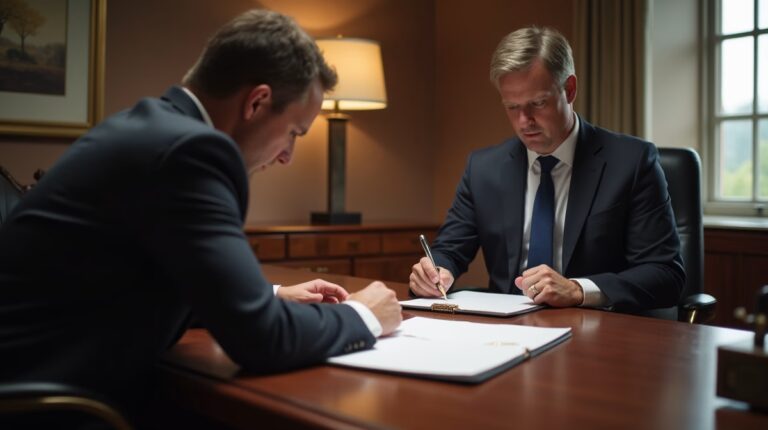
I recently met with Emily, a distraught client who discovered her mother had signed a codicil to her Trust just weeks before passing, removing Emily as a beneficiary. Unfortunately, the codicil was improperly witnessed – a common mistake that rendered it unenforceable. Emily lost over $250,000 she had reasonably expected to inherit, all because of a technicality. This highlights a critical point: disinheriting a child isn’t simply a matter of changing a document; it requires meticulous legal execution.
As an Estate Planning Attorney and CPA with over 35 years of experience in Escondido, California, I’ve seen countless situations where well-intentioned estate plans unravel due to preventable errors. Successfully disinheriting a child in California requires a clear understanding of the legal hurdles and a proactive approach to safeguard your wishes. A key benefit of my dual expertise as a CPA is the ability to address the complex tax implications of such a decision, including potential capital gains and the critical step-up in basis for assets like real estate.
What are the requirements for a valid disinheritance in California?

California law permits you to disinherit a child, but the process isn’t automatic. Your Trust or Will must explicitly state your intent to exclude the child. A simple omission of their name isn’t sufficient. The language must be unambiguous and clearly demonstrate a deliberate decision to deny them any inheritance. Furthermore, the document must be properly signed and witnessed according to California Probate Code requirements.
How does AB 2016 impact disinheritance of a home?
For deaths on or after April 1, 2025, California’s AB 2016 provides a streamlined process for transferring a primary residence valued up to $750,000 through a Petition for Succession. However, this only applies if the home is the decedent’s primary residence. It’s vital to understand that this is a Petition requiring a Judge’s Order, unlike the Small Estate Affidavit used for timeshares or vacant land valued under $69,625. Critically, to qualify for the AB 2016 process, the decedent’s other assets—cash, stocks, etc.—typically must remain below the $208,850 Small Estate threshold. If the overall estate value exceeds this, formal probate proceedings will likely be necessary, even with AB 2016. Disinheriting a child becomes more complex if real estate is involved.
What if my child contests the disinheritance?
Disinherited children have the right to contest a Will or Trust, claiming undue influence, lack of capacity, or improper execution. This can lead to costly and time-consuming litigation. To mitigate this risk, it’s essential to maintain clear documentation of your reasoning for disinheritance, and ensure the process is conducted with transparency and legal counsel. A strong estate plan anticipates potential challenges and includes provisions to address them.
What about digital assets and crypto in my estate?
Without specific RUFADAA language (Probate Code § 870) in your Trust or Will, service providers like Coinbase and Google can legally deny your executor access to your digital assets. This is especially critical if you’ve disinherited a child who might otherwise have been granted access to these accounts. Proactive inclusion of RUFADAA provisions ensures your digital assets are distributed according to your wishes, even in the face of a contest.
- Proper Execution: Ensure your Trust or Will is meticulously signed and witnessed in compliance with California law.
- Clear Intent: Explicitly state your intent to disinherit the child, using unambiguous language.
- Documentation: Maintain records supporting your decision, minimizing the risk of a successful contest.
- Tax Planning: Consider the tax implications of disinheritance, particularly capital gains taxes on the distribution of assets.
While addressing this specific concern is vital, your entire estate plan relies on the enforceability of your Last Will and Testament.
In my 32 years of practice in Riverside County, I have seen many estate plans fail not because of specific asset errors, but because the underlying Will was ambiguous.
Here is how California courts evaluate the true intent and validity of your estate documents:
What makes a California will legally enforceable when it matters most?
In California, a last will and testament is reviewed under probate standards that focus on intent, capacity, and execution. Clear drafting reduces ambiguity, limits misinterpretation, and helps families avoid unnecessary conflict during estate administration.
- Clarity: Avoid vague terms that trigger probate disputes.
- Incapacity: verify mental state at signing.
- Omissions: check for missing amendments often.
For California residents, understanding how intent, authority, and compliance interact is one of the most effective ways to protect family harmony and estate integrity. A will that anticipates probate scrutiny is far more likely to be honored as written and far less likely to become the source of unnecessary conflict.
Resources for Asset Management & Transfer
-
Property Tax Reassessment: California State Board of Equalization (Prop 19)
This page details the “Base Year Value Transfer” rules. It explains that heirs can only avoid a property tax reassessment if the inherited home becomes their primary residence and a claim is filed within one year of the date of death. -
Real Estate Probate (AB 2016): California Probate Code § 13151 (Petition for Succession)
The specific statute for the AB 2016 process. It outlines the requirements for using a court-approved “Petition” (not an affidavit) to transfer a primary residence worth $750,000 or less (gross value) for deaths occurring after April 1, 2025. -
Small Estate Affidavit: California Probate Code § 13100 (Personal Property)
Access the statutory language for the “Small Estate Affidavit.” This procedure is strictly for Personal Property (cash, stocks, vehicles) and is limited to estates with a total value of $208,850 or less (effective April 1, 2025). -
Federal Estate Tax: IRS Estate Tax Guidelines
The authoritative federal resource for estate valuation. It reflects the 2026 exemption increase to $15 million per person established by the One Big Beautiful Bill Act (OBBBA), which is critical for high-net-worth asset planning. -
Unclaimed Assets: California State Controller – Unclaimed Property
The primary portal for executors and heirs to search for “lost” assets—such as forgotten bank accounts, uncashed dividends, and insurance benefits—that have been remitted to the State of California for safekeeping. -
Business/LLC Compliance: FinCEN – Beneficial Ownership Information (BOI)
The official portal for corporate transparency reporting. While many domestic U.S. LLCs received exemptions in 2025, executors managing foreign-registered entities or specific non-exempt structures must still consult this resource to ensure compliance.
|
Attorney Advertising, Legal Disclosure & Authorship
ATTORNEY ADVERTISING.
This content is provided for general informational and educational purposes only and does not constitute legal, financial, or tax advice. Under the California Rules of Professional Conduct and State Bar advertising regulations, this material may be considered attorney advertising. Reading this content does not create an attorney-client relationship or any professional advisory relationship. Laws vary by jurisdiction and are subject to change, including recent 2026 developments under California’s AB 2016 and evolving federal estate and reporting requirements. You should consult a qualified attorney or advisor regarding your specific circumstances before taking action.
Responsible Attorney:
Steven F. Bliss, California Attorney (Bar No. 147856).
Local Office:
Escondido Probate Law720 N Broadway 107 Escondido, CA 92025 (760) 884-4044
Escondido Probate Law is a practice location and trade name used by Steven F. Bliss, Esq., a California-licensed attorney.
About the Author & Legal Review Process
This article was researched and drafted by the Legal Editorial Team of the Law Firm of Steven F. Bliss, Esq.,
a collective of attorneys, legal writers, and paralegals dedicated to translating complex legal concepts into clear, accurate guidance.
Legal Review:
This content was reviewed and approved by Steven F. Bliss, a California-licensed attorney (Bar No. 147856). Mr. Bliss concentrates his practice in estate planning and estate administration, advising clients on proactive planning strategies and representing fiduciaries in probate and trust administration proceedings when formal court involvement becomes necessary.
With more than 35 years of experience in California estate planning and estate administration,
Mr. Bliss focuses on structuring enforceable estate plans, guiding fiduciaries through court-supervised proceedings, resolving creditor and notice issues, and coordinating asset management to support compliant, timely distributions and reduce fiduciary risk. |