
|
Legal & Tax Disclosure
ATTORNEY ADVERTISING.
This article is provided for general informational purposes only and does not constitute legal, financial, or tax advice. Reading this content does not create an attorney-client or professional advisory relationship. Laws vary by jurisdiction and are subject to change. You should consult a qualified professional regarding your specific circumstances. |
I recently had a client, David, who thought he’d cleverly shielded assets by renting a small apartment in Escondido for just a few months each year. He envisioned it as a loophole, a way to avoid California’s potential estate and income taxes. Unfortunately, David’s hastily drafted codicil – attempting to change his domicile to California solely based on that rental – was invalidated. The cost? A significant tax liability that could have been avoided with proper planning. It’s a common misconception that simply having a physical address is enough to establish domicile. It’s far more complex.
As an Estate Planning Attorney and CPA with over 35 years of experience, I’ve seen this scenario play out countless times. Many believe a change of address is sufficient, but the California Franchise Tax Board (FTB) digs much deeper. My CPA background is particularly crucial here; understanding the implications for step-up in basis, capital gains, and proper asset valuation requires a financial perspective most estate planning attorneys lack. This is especially vital for high-net-worth individuals with complex financial holdings.
What Exactly Is Domicile?
Domicile isn’t just where you physically reside; it’s where you intend to make your permanent home. It’s the place you return to, even when absent. It’s a legal concept with significant tax and estate planning ramifications. Establishing domicile is crucial for determining which state’s laws govern your estate, and where your assets will be subject to probate or estate tax.
How Does the FTB Determine Your Domicile?
The FTB doesn’t simply accept a change of address as conclusive proof of domicile. They employ what’s known as the “Closest Connection” test, evaluating up to 19 different factors to determine your true, intended residence. These factors aren’t weighted equally, and no single factor is definitive, but they paint a comprehensive picture of your life and intentions.
- Location of Your Primary Home: While you may rent in Escondido, where is your primary residence? Where do you spend the majority of your time?
- Driver’s License & Vehicle Registration: A California driver’s license and registered vehicles are strong indicators, but not conclusive.
- Bank Accounts & Investments: Where are the majority of your financial accounts located?
- Medical Professionals: Where do you receive regular medical care – your primary doctor, dentist, specialists?
- Social & Religious Connections: Where are your close friends, family, and religious affiliations?
- Voter Registration: Are you registered to vote in California?
It’s important to understand that spending less than 183 days in California does not automatically terminate residency; the FTB uses the “Closest Connection” test (evaluating 19 factors like your primary doctor and social ties) to determine domicile.
What About Real Estate and Estate Size?
If your estate is relatively small, the process can be streamlined. However, even with modest assets, understanding the options is key. For deaths on or after April 1, 2025, a primary residence valued up to $750,000 qualifies for a ‘Petition for Succession’ under AB 2016 (Probate Code § 13151). It’s crucial to distinguish this as a “Petition” that requires a Judge’s Order, NOT an “Affidavit.” It’s also important to remember that to qualify, the decedent’s other non-real estate assets (cash, stocks, etc.) must typically remain below the separate $208,850 Small Estate limit. For real property valued below $69,625—think timeshares or vacant land—the Small Estate Affidavit remains an option.
How Does Domicile Impact Taxes?
Your domicile dictates which state can tax your income and estate. California is a high-tax state, and avoiding it legally requires meticulous planning. A properly established domicile in a different state can shield your assets from California’s estate tax, and potentially reduce your income tax liability. The FTB is particularly diligent in auditing residency claims, and they will use Form 4600 (Residency Questionnaire) to scrutinize your life, including the location of your dentist, the registration of your pets, and where you keep your safe deposit boxes.
Furthermore, the 2026 ‘Sunset’ was averted by the One Big Beautiful Bill Act (OBBBA), which permanently increased the Federal Estate Tax Exemption to $15 million per person effective January 1, 2026. While this provides more flexibility federally, California’s estate tax considerations remain significant.
Finally, if you own a business, remember that moving yourself doesn’t move your business income; under updated Regulation Section 25136-2 (effective Jan 1, 2026), California sources asset management fees based on the domicile of the underlying investors, not the fund itself.
While addressing this specific concern is vital, your entire estate plan relies on the enforceability of your Last Will and Testament.
Too often, families resolve one specific issue but leave their broader estate vulnerable to litigation due to poor Will drafting.
Here is how California courts evaluate the true intent and validity of your estate documents:
What does a California probate court look for when interpreting testamentary intent?
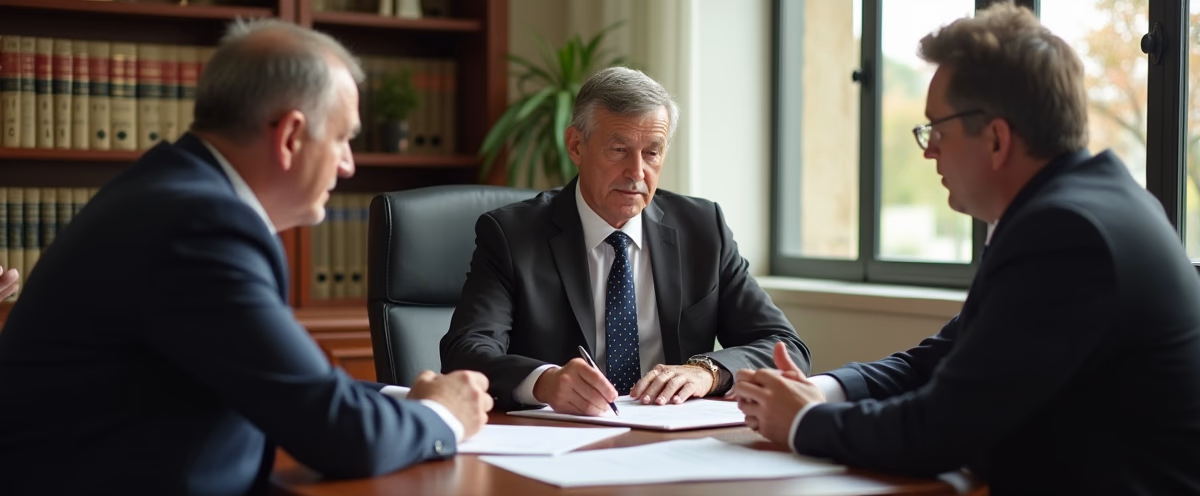
In California, a last will and testament is reviewed under probate standards that focus on intent, capacity, and execution. Clear drafting reduces ambiguity, limits misinterpretation, and helps families avoid unnecessary conflict during estate administration.
- Leadership: Define executor duties clearly.
- Guardians: Establish guardian nominations for minors.
- Jurisdiction: Confirm residency rules.
For California residents, understanding how intent, authority, and compliance interact is one of the most effective ways to protect family harmony and estate integrity. A will that anticipates probate scrutiny is far more likely to be honored as written and far less likely to become the source of unnecessary conflict.
Controlling Legal Standards for Establishing Domicile and Residency
-
Residency Guidelines: FTB Pub 1031 (Guidelines for Determining Resident Status)
This is the primary resource for the “Closest Connection” test. In 2026, it details how the FTB evaluates 19 factors—including the location of your healthcare providers and social ties—to determine if your presence in the state is “permanent” or merely “transitory.” -
Voter Registration: California Secretary of State – Voter Registration
Updating your voting address is a critical indicator of intent. For the June 2, 2026, Primary Election, the deadline to register online is May 18, 2026. This serves as a public declaration of your primary home. -
Federal Estate Tax: IRS Estate Tax Overview
While domicile determines state tax, this resource outlines federal guidelines. It reflects the 2026 OBBBA update, which permanently set the federal estate tax exemption at $15 million per person ($30 million for couples), indexed for inflation. -
Proof of Residency: California DMV – REAL ID Checklist
Since the federal enforcement deadline passed in 2025, a REAL ID is mandatory for domestic flights. This page lists the specific residency documents (e.g., utility bills, tax returns) that the state accepts as proof of a permanent California address.
|
Attorney Advertising, Legal Disclosure & Authorship
ATTORNEY ADVERTISING.
This content is provided for general informational and educational purposes only and does not constitute legal, financial, or tax advice. Under the California Rules of Professional Conduct and State Bar advertising regulations, this material may be considered attorney advertising. Reading this content does not create an attorney-client relationship or any professional advisory relationship. Laws vary by jurisdiction and are subject to change, including recent 2026 developments under California’s AB 2016 and evolving federal estate and reporting requirements. You should consult a qualified attorney or advisor regarding your specific circumstances before taking action.
Responsible Attorney:
Steven F. Bliss, California Attorney (Bar No. 147856).
Local Office:
Escondido Probate Law720 N Broadway 107 Escondido, CA 92025 (760) 884-4044
Escondido Probate Law is a practice location and trade name used by Steven F. Bliss, Esq., a California-licensed attorney.
About the Author & Legal Review Process
This article was researched and drafted by the Legal Editorial Team of the Law Firm of Steven F. Bliss, Esq.,
a collective of attorneys, legal writers, and paralegals dedicated to translating complex legal concepts into clear, accurate guidance.
Legal Review:
This content was reviewed and approved by Steven F. Bliss, a California-licensed attorney (Bar No. 147856). Mr. Bliss concentrates his practice in estate planning and estate administration, advising clients on proactive planning strategies and representing fiduciaries in probate and trust administration proceedings when formal court involvement becomes necessary.
With more than 35 years of experience in California estate planning and estate administration,
Mr. Bliss focuses on structuring enforceable estate plans, guiding fiduciaries through court-supervised proceedings, resolving creditor and notice issues, and coordinating asset management to support compliant, timely distributions and reduce fiduciary risk. |