
|
Legal & Tax Disclosure
ATTORNEY ADVERTISING.
This article is provided for general informational purposes only and does not constitute legal, financial, or tax advice. Reading this content does not create an attorney-client or professional advisory relationship. Laws vary by jurisdiction and are subject to change. You should consult a qualified professional regarding your specific circumstances. |
I recently spoke with Emily, a frantic daughter who discovered her mother’s trust amendment – a codicil seemingly written during a hospital stay, heavily influenced by a new “friend” who also happened to be her mother’s caregiver. Emily feared the worst: a significant shift in inheritance away from her and her siblings. But the real crisis wasn’t just the suspicious amendment; it was the timing. She’d waited three months to consult an attorney, and now she was staring at a potentially insurmountable legal hurdle, facing the loss of substantial assets due to missing a critical deadline. The potential cost? Hundreds of thousands of dollars.
As an Estate Planning Attorney and CPA with over 35 years of experience here in Escondido, I see this scenario play out far too often. People understandably delay seeking legal advice, hoping things will resolve themselves, or believing they have plenty of time. But when it comes to challenging a trust or will, time is absolutely of the essence. And the clock starts ticking the moment you’re formally notified of the trust’s terms.
How Long Do I Have to Challenge a Trust?
The biggest misconception is that you have years to contest a trust. That’s rarely the case. California law, specifically Probate Code § 16061.7, has created a rigid framework with a surprisingly short window for action. Once a trustee serves the mandatory § 16061.7 Notification, a strict 120-day clock begins; if a beneficiary fails to file a contest within this window, they are essentially barred from challenging the trust’s validity forever. This isn’t just a suggestion; it’s a firm deadline.
Now, a “17200 Petition” – technically a Petition for Trust Account and Report under Probate Code section 17200 – isn’t the contest itself, but it’s a crucial prerequisite. It compels the trustee to provide a detailed accounting of all trust assets, income, and disbursements. This information is essential to identify potential wrongdoing, such as self-dealing, mismanagement, or misappropriation of funds. But here’s where the deadlines intertwine:
The 17200 Petition & the 120-Day Rule
While there isn’t a direct deadline to file a 17200 Petition, strategically, you need to file it as soon as possible after receiving the § 16061.7 notification. Why? Because the trustee has 30 days to respond. Gathering that accounting information takes time, and you need that information before the 120-day window for a full trust contest closes. If you wait until the 110th day to request the accounting, you’ve effectively lost your opportunity to properly investigate and, if necessary, file a challenge.
What Happens if I Miss the Deadline?
Missing the 120-day deadline is devastating. It doesn’t necessarily mean the trust is ironclad, but it drastically limits your options. You may be forced to pursue alternative legal theories – like breach of fiduciary duty – which are often more complex and difficult to prove. Or, you might be stuck accepting a trust distribution that is demonstrably unfair.
Disinheriting Challengers: The No-Contest Clause
Many trusts contain “No-Contest Clauses,” designed to discourage beneficiaries from challenging the document. However, Probate Code § 21311 provides some protection. Under this statute, a “No-Contest Clause” is only enforceable if the challenger brought the lawsuit without probable cause; simply suing the trustee does not automatically trigger disinheritance. Careful legal drafting and a solid factual basis are crucial when pursuing a trust contest with a no-contest provision.
The CPA Advantage: Stepping Up Basis & Valuation
As a CPA as well as an attorney, I bring a unique perspective to trust and estate litigation. Often, the core of these disputes isn’t simply who gets what, but how much it’s worth. Accurate valuation of assets, understanding the complexities of the “step-up in basis” for inherited property (and avoiding unnecessary capital gains taxes), and meticulously reconstructing financial records are all areas where my dual credentials provide significant advantages to my clients.
What determines whether a California trust settlement remains private or erupts into public litigation?
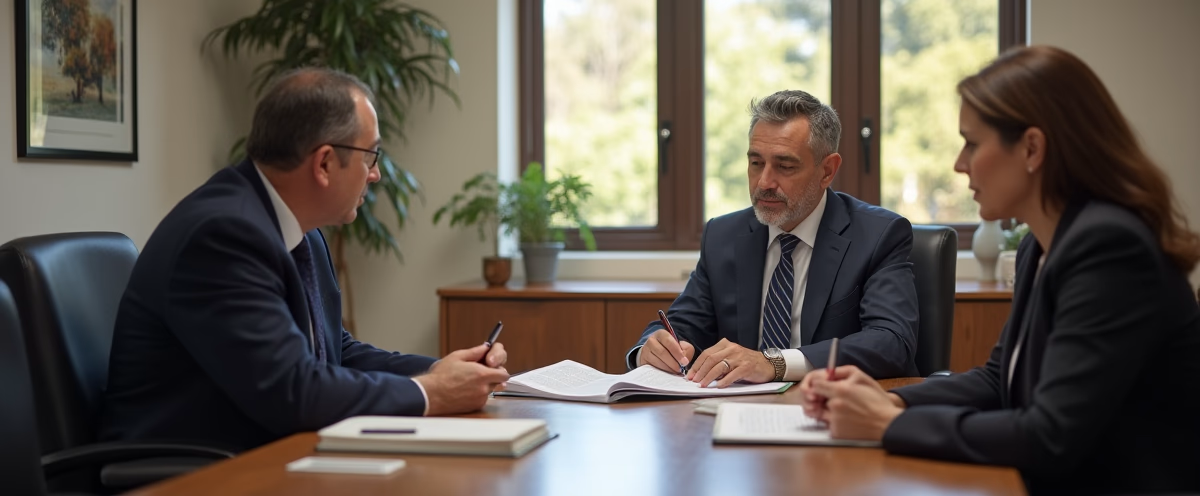
Success in trust administration depends on more than just the document; it requires active management of assets, precise accounting to beneficiaries, and careful navigation of tax rules. Whether dealing with a blended family or complex real estate, understanding the mechanics of trust law is the only way to ensure the grantor’s wishes survive scrutiny.
- Asset Protection: Explore permanent trust structures for asset shielding.
- Will Integration: Understand testamentary trusts.
- Policy Management: Utilize an ILIT strategies for estate taxes.
California trust planning is most effective when the structure is matched to the specific family goal and assets are fully funded into the trust name. When administration is handled with transparency and adherence to the Probate Code, the trust can fulfill its promise of privacy and efficiency.
Verified Authority on California Trust Litigation & Disputes
-
The 120-Day Rule (Probate Code § 16061.7): California Probate Code § 16061.7
The most critical statute in trust litigation. It establishes the 120-day deadline for contesting a trust after the notification is mailed. Missing this deadline usually ends the case before it starts. -
Caregiver Presumption (Probate Code § 21380): California Probate Code § 21380
This statute protects seniors by presuming that gifts to care custodians are the result of fraud or undue influence. It is the primary weapon used to overturn “deathbed amendments” that favor a caregiver over family. -
No-Contest Clauses (Probate Code § 21311): California Probate Code § 21311
Defines the strict limits on enforcing penalty clauses. It explains that a beneficiary can only be disinherited for suing if they lacked “probable cause” to bring the lawsuit. -
Petition for Instructions (Probate Code § 17200): California Probate Code § 17200
The “gateway” statute for most trust litigation. It allows a trustee or beneficiary to petition the court for instructions regarding the internal affairs of the trust, from interpreting terms to removing a trustee. -
Asset Recovery “Backup” (AB 2016): California Probate Code § 13151 (Petition for Succession)
Effective April 1, 2025, this statute provides a streamlined path (Judge’s Order) to resolve disputes over ownership of a primary residence valued up to $750,000, often avoiding costly Heggstad litigation. -
Digital Discovery (RUFADAA): California Probate Code § 870 (RUFADAA)
Essential for modern litigation. This act governs who can access a decedent’s digital communications—often the “smoking gun” evidence in undue influence or capacity trials.
|
Attorney Advertising, Legal Disclosure & Authorship
ATTORNEY ADVERTISING.
This content is provided for general informational and educational purposes only and does not constitute legal, financial, or tax advice. Under the California Rules of Professional Conduct and State Bar advertising regulations, this material may be considered attorney advertising. Reading this content does not create an attorney-client relationship or any professional advisory relationship. Laws vary by jurisdiction and are subject to change, including recent 2026 developments under California’s AB 2016 and evolving federal estate and reporting requirements. You should consult a qualified attorney or advisor regarding your specific circumstances before taking action.
Responsible Attorney:
Steven F. Bliss, California Attorney (Bar No. 147856).
Local Office:
Escondido Probate Law720 N Broadway 107 Escondido, CA 92025 (760) 884-4044
Escondido Probate Law is a practice location and trade name used by Steven F. Bliss, Esq., a California-licensed attorney.
About the Author & Legal Review Process
This article was researched and drafted by the Legal Editorial Team of the Law Firm of Steven F. Bliss, Esq.,
a collective of attorneys, legal writers, and paralegals dedicated to translating complex legal concepts into clear, accurate guidance.
Legal Review:
This content was reviewed and approved by Steven F. Bliss, a California-licensed attorney (Bar No. 147856). Mr. Bliss concentrates his practice in estate planning and estate administration, advising clients on proactive planning strategies and representing fiduciaries in probate and trust administration proceedings when formal court involvement becomes necessary.
With more than 35 years of experience in California estate planning and estate administration,
Mr. Bliss focuses on structuring enforceable estate plans, guiding fiduciaries through court-supervised proceedings, resolving creditor and notice issues, and coordinating asset management to support compliant, timely distributions and reduce fiduciary risk. |