
|
Legal & Tax Disclosure
ATTORNEY ADVERTISING.
This article is provided for general informational purposes only and does not constitute legal, financial, or tax advice. Reading this content does not create an attorney-client or professional advisory relationship. Laws vary by jurisdiction and are subject to change. You should consult a qualified professional regarding your specific circumstances. |
I recently received a frantic call from Emily, a small business owner in Carlsbad. Her father had passed away unexpectedly, and she discovered a Buy-Sell Agreement existed between him and his business partner. The problem? Her father’s estate plan – a carefully drafted Trust – dictated that she inherit the business shares. Emily was understandably upset; she’d assumed she was set, only to find out a contract she didn’t even know about could potentially nullify years of estate planning. Unfortunately, this isn’t uncommon.
The short answer is: potentially, yes, a Buy-Sell Agreement can override a Trust, but it’s rarely a simple situation. The controlling factor isn’t the existence of the agreement itself, but rather how it was structured and the language used within both the Trust and the Buy-Sell Agreement. A properly executed Buy-Sell Agreement is a legally binding contract, and contracts generally take precedence over provisions within a Will or Trust, provided they’re valid and enforceable.
Here’s where it gets complicated. As an attorney and CPA with over 35 years of experience, I’ve seen countless scenarios where a poorly drafted Buy-Sell Agreement created unintended consequences. The key is to examine the agreement’s trigger events. Was the agreement triggered by the father’s death as stipulated, or did it require a specific offer and acceptance process? If the agreement was triggered automatically upon death, and the Trust doesn’t specifically address this scenario, the agreement is likely to hold up. However, if the Trust includes a clause stating that beneficiaries inherit shares outright regardless of any Buy-Sell Agreements, it might provide protection.
What if the Buy-Sell Agreement wasn’t disclosed?
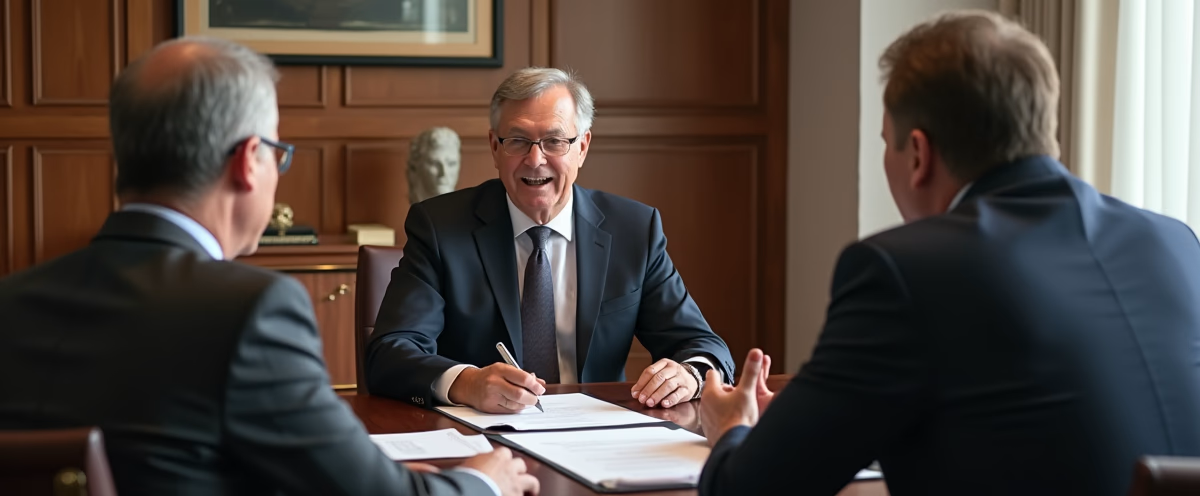
A major issue arises when the Buy-Sell Agreement wasn’t properly disclosed to the beneficiary, in this case Emily. While the agreement itself may be valid, a lack of transparency can be grounds for legal challenge. California courts frown upon hidden contracts that significantly alter a beneficiary’s expected inheritance. If Emily can prove her father intentionally concealed the agreement, or if the terms are demonstrably unfair, she may have a strong case to set aside the agreement. This is where having a CPA involved is crucial; we can analyze the economic implications of the Buy-Sell Agreement and assess whether it constitutes a gift or a transfer at less than fair market value, which could have estate tax consequences.
Buy-Sell Agreements and Business Interests – What you need to know
The complexities are heightened when dealing with business interests, especially Limited Liability Companies (LLCs). As of March 2025, domestic U.S. LLCs are exempt from mandatory BOI reporting under the Corporate Transparency Act; however, executors managing foreign-registered entities must still file updates within 30 days to avoid fines of $500/day. It’s vital that the Buy-Sell Agreement clearly defines the valuation method for the business shares. A vague valuation can lead to disputes and costly litigation. Furthermore, the Trust needs to be coordinated with the operating agreement of the LLC to ensure a smooth transfer of ownership. If the Buy-Sell Agreement attempts to bypass the Trust’s provisions regarding business control or distribution of profits, it may be deemed invalid.
Protecting Your Estate Plan: A Proactive Approach
Emily’s situation highlights the importance of proactive estate planning. A well-drafted Trust is only as effective as its ability to address potential conflicts. When creating a Trust, it’s essential to disclose all existing contracts – including Buy-Sell Agreements – to your attorney. This allows us to incorporate provisions specifically addressing these agreements and mitigating potential risks. Regularly reviewing your estate plan is equally critical, especially after any significant business changes or contract updates. Don’t rely on a “one-and-done” approach.
Furthermore, consider the potential impact on the property tax base. Under Prop 19, heirs can only keep a parent’s low property tax base if they move into the home as their primary residence within one year and the home’s value is within specific limits. If the Buy-Sell Agreement involves the sale of a property, this needs to be factored into the overall estate planning strategy. Without specific RUFADAA language (Probate Code § 870) in your Trust or Will, service providers like Coinbase and Google can legally deny your executor access to your digital assets.
What if the Estate Exceeds Thresholds?
Finally, we must consider the overall estate size. If combined ‘probate assets’ (excluding the AB 2016 residence) exceed $208,850 (the threshold effective April 1, 2025), they are subject to formal probate; a Will alone does not allow you to bypass this limit. For high net-worth clients, the OBBBA (One Big Beautiful Bill Act) permanently increased the Federal Estate Tax Exemption to $15 million per person effective Jan 1, 2026, providing some flexibility in estate planning. A Buy-Sell Agreement may be a valuable tool for reducing estate taxes, but only if it’s integrated seamlessly with the larger estate plan.
Understanding this specific rule is helpful, but it is ultimately the strength of your underlying Will that protects your legacy.
Too often, families resolve one specific issue but leave their broader estate vulnerable to litigation due to poor Will drafting.
Understanding the following standards is critical to ensuring your wishes are honored in probate court:
What does a California probate court look for when interpreting testamentary intent?
In California, a last will and testament operates within a probate system that emphasizes intent, clarity, and procedural compliance. When properly drafted, a will does more than distribute property—it creates legally enforceable instructions that guide courts, fiduciaries, and beneficiaries through administration with fewer disputes and less uncertainty.
To distribute property effectively, you must define estate assets, clarify who inherits, and understand how estate liabilities impact the final distribution.
When a will is drafted with California probate review in mind, it becomes a stabilizing roadmap rather than a source of conflict. Clear intent, proper authority, and compliant execution protect both families and estates.
Resources for Asset Management & Transfer
-
Property Tax Reassessment: California State Board of Equalization (Prop 19)
This page details the “Base Year Value Transfer” rules. It explains that heirs can only avoid a property tax reassessment if the inherited home becomes their primary residence and a claim is filed within one year of the date of death. -
Real Estate Probate (AB 2016): California Probate Code § 13151 (Petition for Succession)
The specific statute for the AB 2016 process. It outlines the requirements for using a court-approved “Petition” (not an affidavit) to transfer a primary residence worth $750,000 or less (gross value) for deaths occurring after April 1, 2025. -
Small Estate Affidavit: California Probate Code § 13100 (Personal Property)
Access the statutory language for the “Small Estate Affidavit.” This procedure is strictly for Personal Property (cash, stocks, vehicles) and is limited to estates with a total value of $208,850 or less (effective April 1, 2025). -
Federal Estate Tax: IRS Estate Tax Guidelines
The authoritative federal resource for estate valuation. It reflects the 2026 exemption increase to $15 million per person established by the One Big Beautiful Bill Act (OBBBA), which is critical for high-net-worth asset planning. -
Unclaimed Assets: California State Controller – Unclaimed Property
The primary portal for executors and heirs to search for “lost” assets—such as forgotten bank accounts, uncashed dividends, and insurance benefits—that have been remitted to the State of California for safekeeping. -
Business/LLC Compliance: FinCEN – Beneficial Ownership Information (BOI)
The official portal for corporate transparency reporting. While many domestic U.S. LLCs received exemptions in 2025, executors managing foreign-registered entities or specific non-exempt structures must still consult this resource to ensure compliance.
|
Attorney Advertising, Legal Disclosure & Authorship
ATTORNEY ADVERTISING.
This content is provided for general informational and educational purposes only and does not constitute legal, financial, or tax advice. Under the California Rules of Professional Conduct and State Bar advertising regulations, this material may be considered attorney advertising. Reading this content does not create an attorney-client relationship or any professional advisory relationship. Laws vary by jurisdiction and are subject to change, including recent 2026 developments under California’s AB 2016 and evolving federal estate and reporting requirements. You should consult a qualified attorney or advisor regarding your specific circumstances before taking action.
Responsible Attorney:
Steven F. Bliss, California Attorney (Bar No. 147856).
Local Office:
Escondido Probate Law720 N Broadway 107 Escondido, CA 92025 (760) 884-4044
Escondido Probate Law is a practice location and trade name used by Steven F. Bliss, Esq., a California-licensed attorney.
About the Author & Legal Review Process
This article was researched and drafted by the Legal Editorial Team of the Law Firm of Steven F. Bliss, Esq.,
a collective of attorneys, legal writers, and paralegals dedicated to translating complex legal concepts into clear, accurate guidance.
Legal Review:
This content was reviewed and approved by Steven F. Bliss, a California-licensed attorney (Bar No. 147856). Mr. Bliss concentrates his practice in estate planning and estate administration, advising clients on proactive planning strategies and representing fiduciaries in probate and trust administration proceedings when formal court involvement becomes necessary.
With more than 35 years of experience in California estate planning and estate administration,
Mr. Bliss focuses on structuring enforceable estate plans, guiding fiduciaries through court-supervised proceedings, resolving creditor and notice issues, and coordinating asset management to support compliant, timely distributions and reduce fiduciary risk. |