
|
Legal & Tax Disclosure
ATTORNEY ADVERTISING.
This article is provided for general informational purposes only and does not constitute legal, financial, or tax advice. Reading this content does not create an attorney-client or professional advisory relationship. Laws vary by jurisdiction and are subject to change. You should consult a qualified professional regarding your specific circumstances. |
I recently had a client, Walter, discover a codicil to his mother’s Will had been misplaced during a move. By the time we located it – six months later – the delay had triggered unnecessary legal hurdles and increased estate administration costs by nearly $5,000. This highlights a critical point: understanding the executor’s role before a death occurs can save your family significant time, expense, and heartache.
As an estate planning attorney and CPA with over 35 years of experience here in Escondido, I often guide clients through the intricacies of Will execution and the responsibilities that fall on the appointed executor. Many assume it’s simply signing papers, but the role is far more complex – and carries significant legal weight. It’s not just about following instructions; it’s about safeguarding assets, fulfilling wishes, and navigating potential disputes. The CPA side of my practice is particularly valuable here, allowing me to see beyond just the legal documents to the tax implications every step of the way, especially regarding the crucial step-up in basis for inherited assets.
What are the First Steps for an Executor?
Immediately after being named in a Will, and before doing anything else, you need to petition the court to be officially appointed as the executor. This involves filing the original Will and a death certificate with the probate court in the county where the deceased resided. The court will then issue “Letters Testamentary,” which are essentially your authorization to act on behalf of the estate. Do not access bank accounts, sell property, or distribute assets until you have these Letters – doing so can expose you to personal liability.
You also need to identify and inventory all assets. This isn’t just about obvious things like bank accounts and real estate. It includes personal property, investments, life insurance policies, digital assets (more on that later), and any potential claims the estate may have. A thorough inventory is the foundation of responsible estate administration.
What About Debts and Taxes?
Once you have an inventory, you must determine if the estate owes any debts. This includes credit card balances, mortgages, loans, and any outstanding taxes. Creditors have a limited time to file claims against the estate, and you’re legally obligated to address those valid claims before distributing assets to beneficiaries.
This is where my CPA background is invaluable. Understanding tax implications is paramount. The OBBBA permanently set the Federal Estate Tax Exemption at $15 million per person ($30 million for couples) as of January 1, 2026, shielding many estates from federal tax. However, California executors must still file Form 706 to elect ‘portability’ for a surviving spouse, even if no tax is currently owed. Furthermore, understanding the cost basis of inherited assets is crucial. As a CPA, I can maximize the step-up in basis to minimize future capital gains taxes for your heirs.
How Do I Deal with Digital Assets?
In today’s world, digital assets are a significant part of most estates. This includes online accounts, social media profiles, cryptocurrency, and digital photos. Accessing these assets can be challenging, as privacy laws are strict. Under California RUFADAA (Probate Code § 870), executors are legally barred from accessing ‘content’ (emails, private messages, crypto-keys) unless the decedent provided explicit ‘prior consent’ in their Will or Trust. Generic ‘all power’ clauses are legally insufficient for digital content access. Encourage your clients to create a separate digital asset inventory and provide clear instructions regarding access.
What if the Will is Contested?
Unfortunately, Wills are sometimes contested. Family disputes, claims of undue influence, or questions about the testator’s mental capacity can all lead to litigation. If this happens, you’ll need to consult with a probate attorney to defend the Will and protect the estate’s assets. It’s important to remember that as executor, you have a fiduciary duty to act in the best interests of the beneficiaries and the estate as a whole.
What About Probate Avoidance?
Many clients want to avoid probate altogether. For deaths on or after April 1, 2025, executors may avoid full probate for personal property under $208,850. Notably, AB 2016 now allows a simplified ‘Petition to Determine Succession’ for a primary residence valued up to $750,000. Per Probate Code § 13050, you MUST exclude all California-registered vehicles and up to $20,875 in unpaid salary from the small estate calculation. Revocable Living Trusts are an effective way to bypass probate, but they also require an understanding of trust administration, which differs from Will execution.
Solving the immediate legal issue is only the first step; ensuring your foundational documents hold up in court is the next.
In my 32 years of practice in Riverside County, I have seen many estate plans fail not because of specific asset errors, but because the underlying Will was ambiguous.
Understanding the following standards is critical to ensuring your wishes are honored in probate court:
How do California courts decide whether a will reflects true intent or creates ambiguity?
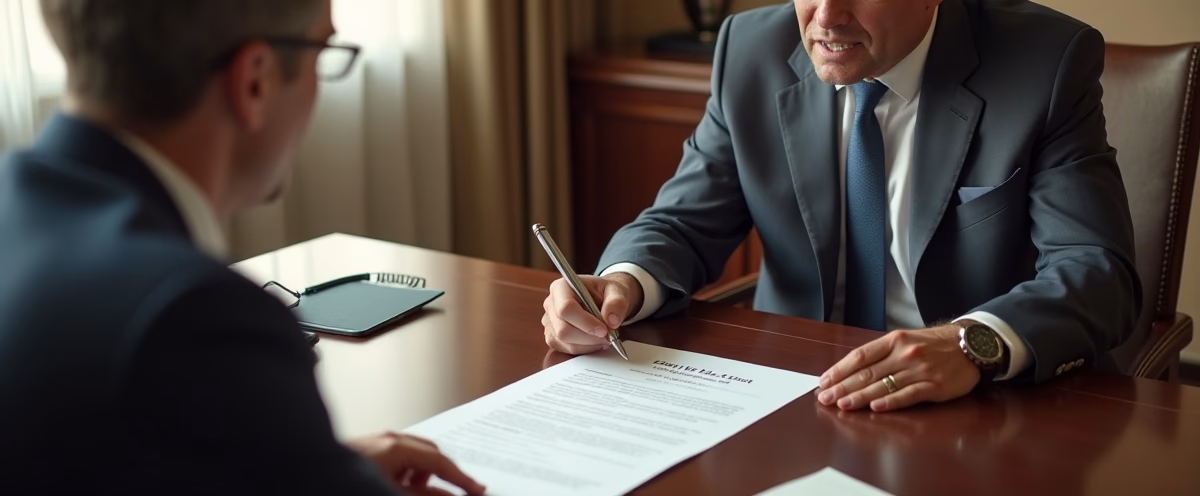
In California, a last will and testament is reviewed under probate standards that focus on intent, capacity, and execution. Clear drafting reduces ambiguity, limits misinterpretation, and helps families avoid unnecessary conflict during estate administration.
- Clarity: Avoid vague terms that trigger interpretation fights.
- Incapacity: verify legal capacity at signing.
- Errors: check for missing amendments often.
When a will is drafted with California probate review in mind, it becomes a stabilizing roadmap rather than a source of conflict. Clear intent, proper authority, and compliant execution protect both families and estates.
Official Legal Standards and Resources for California Executors
-
Mandatory Judicial Forms:
Judicial Council of California – Probate Forms (DE Series)
The official repository for all “Decedents’ Estates” forms; in 2026, this includes mandatory updated forms for the $208,850 Small Estate threshold and the new AB 2016 simplified petitions for primary residences valued under $750,000. -
Riverside County Local Rules:
Riverside Superior Court – Executor FAQ
A localized resource for Riverside County fiduciaries that outlines 2026 requirements for mandatory e-filing, Local Rule 7010 for remote appearances, and specific duties regarding the 4-month creditor claim period. -
Federal Tax Compliance:
IRS Guidelines for Executors (Form 706 & 1041)
The authoritative federal guide for filing a final 1040 and the estate’s 1041; it reflects the 2026 OBBBA update, which established a permanent $15 million individual estate tax exemption, effectively ending the previous “tax cliff” uncertainty. -
Statutory Duty of Care:
California Probate Code § 9600 (The Prudent Person Rule)
Codifies the “Prudent Person Rule,” stipulating that an executor must manage estate assets with reasonable care and skill; it remains the primary legal standard in 2026 for determining if a fiduciary is liable for mismanagement or “surcharge.” -
Digital Asset Authority:
Revised Uniform Fiduciary Access to Digital Assets Act (RUFADAA)
Access California Probate Code §§ 870-884, which governs an executor’s power to manage online accounts; it clarifies why service providers can legally block access to private emails and crypto-wallets without explicit “prior consent” in the estate plan.
|
Attorney Advertising, Legal Disclosure & Authorship
ATTORNEY ADVERTISING.
This content is provided for general informational and educational purposes only and does not constitute legal, financial, or tax advice. Under the California Rules of Professional Conduct and State Bar advertising regulations, this material may be considered attorney advertising. Reading this content does not create an attorney-client relationship or any professional advisory relationship. Laws vary by jurisdiction and are subject to change, including recent 2026 developments under California’s AB 2016 and evolving federal estate and reporting requirements. You should consult a qualified attorney or advisor regarding your specific circumstances before taking action.
Responsible Attorney:
Steven F. Bliss, California Attorney (Bar No. 147856).
Local Office:
Escondido Probate Law720 N Broadway 107 Escondido, CA 92025 (760) 884-4044
Escondido Probate Law is a practice location and trade name used by Steven F. Bliss, Esq., a California-licensed attorney.
About the Author & Legal Review Process
This article was researched and drafted by the Legal Editorial Team of the Law Firm of Steven F. Bliss, Esq.,
a collective of attorneys, legal writers, and paralegals dedicated to translating complex legal concepts into clear, accurate guidance.
Legal Review:
This content was reviewed and approved by Steven F. Bliss, a California-licensed attorney (Bar No. 147856). Mr. Bliss concentrates his practice in estate planning and estate administration, advising clients on proactive planning strategies and representing fiduciaries in probate and trust administration proceedings when formal court involvement becomes necessary.
With more than 35 years of experience in California estate planning and estate administration,
Mr. Bliss focuses on structuring enforceable estate plans, guiding fiduciaries through court-supervised proceedings, resolving creditor and notice issues, and coordinating asset management to support compliant, timely distributions and reduce fiduciary risk. |