This article is provided for general informational purposes only and does not constitute legal, financial, or tax advice.
Reading this content does not create an attorney-client or professional advisory relationship.
Laws vary by jurisdiction and are subject to change. You should consult a qualified professional regarding your specific circumstances.
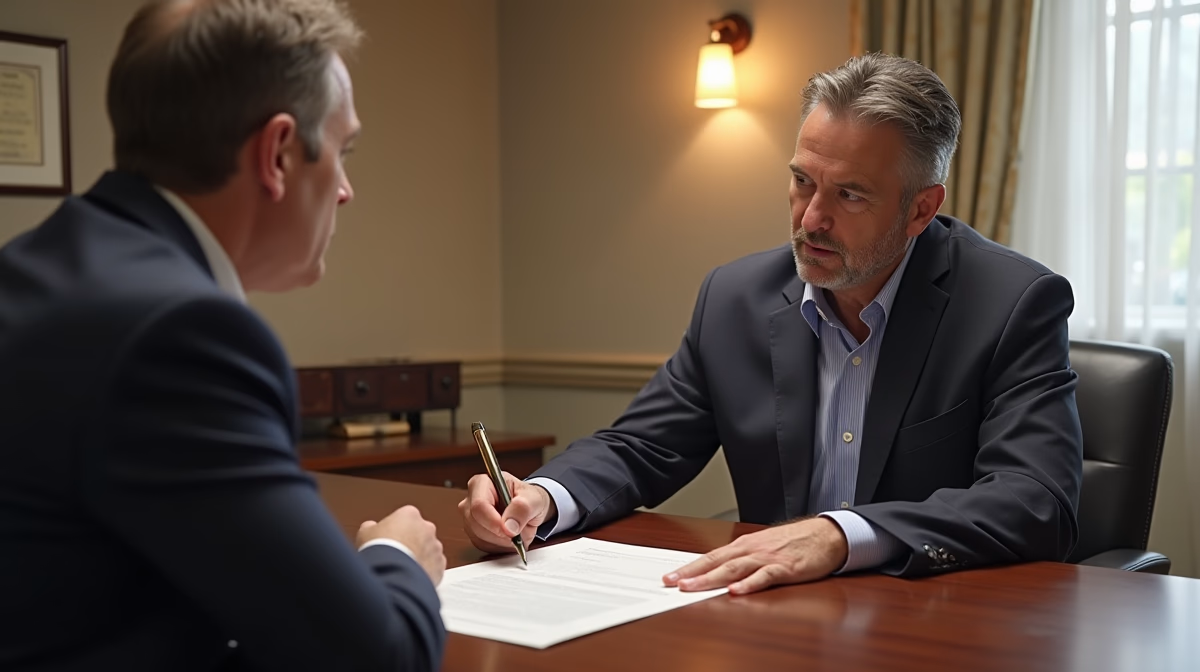
Emily just received notice that her mother, Patricia, passed away. Patricia had a valid Will, but it was a handwritten document – signed, but not witnessed. Emily is devastated, and now faces a legal bill that could easily exceed $10,000 just to determine if the Will is valid enough for probate. A proper estate plan could have saved her this heartache and expense.
As an Estate Planning Attorney and CPA with over 35 years of experience here in Escondido, I’ve seen countless families struggle with the complexities of probate and estate administration. Often, the initial confusion centers around the difference between “Probate of Will” and “Administration.” It’s a vital distinction that impacts the process, the timeline, and ultimately, the cost. Let’s break down those differences.
What Happens When There Is a Valid Will?
When a person dies with a properly executed Will, we typically pursue a “Probate of Will.” This means the court formally validates the Will, confirms it as the decedent’s final wishes, and then oversees the distribution of assets according to those instructions. The person named in the Will to manage the estate—the Executor— petitions the court to begin this process.
However, a seemingly small defect can derail even the best-intentioned Will. Patricia’s situation highlights this perfectly. A Will requires specific formalities—typically two witnesses present during the signing—to be deemed valid. Without that, the court may refuse to admit the Will, and we’re forced into a full Administration proceeding, even though Patricia clearly expressed her wishes in writing.
What is Estate Administration When There’s No Valid Will?
If there’s no valid Will, or if the Will is deemed invalid, the process shifts to “Administration.” In this scenario, the court appoints an “Administrator” – chosen according to a strict statutory priority, as outlined in Probate Code § 8461. This individual then has the responsibility of identifying and collecting the decedent’s assets, paying debts and taxes, and ultimately distributing the remaining assets to the legal heirs.
- Order of Priority: The law dictates a strict order for who can be the Administrator: (1) Surviving Spouse, (2) Children, (3) Grandchildren, (4) Parents, (5) Siblings.
- No Discretion: Unlike an Executor who follows the Will’s instructions, an Administrator must adhere to California’s intestacy laws – the rules governing distribution when there’s no Will.
- Increased Scrutiny: The court exercises closer oversight in Administration cases because there are no pre-approved instructions from the decedent.
What About a Lost Will?
A common problem arises when the original Will is lost or misplaced. Don’t assume a copy is sufficient. If the original Will is missing, you cannot simply attach a copy to the petition. You must check the ‘Lost Will’ box and file a separate declaration proving the Will was not revoked and establishing its contents through witness testimony, per Probate Code § 8223. This adds significant complexity and expense.
What is the Role of the Executor or Administrator?
Both Executors and Administrators have significant responsibilities. They must act as fiduciaries, meaning they have a legal duty to act in the best interests of the estate and its beneficiaries. This includes maintaining accurate records, filing tax returns, and providing regular updates to the court and heirs. The petition asks for ‘Full’ or ‘Limited’ authority under the Independent Administration of Estates Act. You should almost always request Full Authority, which allows you to sell real estate without a court confirmation hearing. Limited authority restricts you to court-supervised sales only.
The CPA Advantage: Maximizing the Benefit for Beneficiaries
As a CPA as well as an attorney, I bring a unique perspective to estate planning and administration. Understanding the tax implications is crucial. For example, properly valuing assets – real estate, business interests, even personal property – is vital to establishing a correct “step-up in basis.” This minimizes capital gains taxes when the beneficiaries eventually sell those assets. A missed opportunity here can cost the family thousands of dollars. I can also ensure all deductions are taken and estate tax returns (if applicable) are filed correctly. Filing a Petition for Probate (Form DE-111) is mandatory if the decedent’s gross estate value exceeds $208,850 (effective April 1, 2025). Below this amount, successors should use the Section 13100 Small Estate Affidavit or AB 2016 Petition for Succession instead.
Furthermore, if the Executor or Administrator lives out of state, the Court may require a bond—essentially insurance to protect the estate from potential mismanagement. Even if the Will waives bond, the Court may still require it. Conversely, if there is no Will, bond is required unless all beneficiaries sign a waiver. The bond amount is based on the value of personal property plus annual income.
Finally, remember the 30-day rule. The person holding the decedent’s original Will has a mandatory legal duty to file it with the Court Clerk within 30 days of learning of the death. Failure to do so can make the custodian liable for all damages caused by the delay, per Probate Code § 8200.
How do enforcement rules in California probate court shape outcomes for heirs and fiduciaries?
The path through California probate is rarely a straight line; it requires precise adherence to statutory deadlines, accurate asset characterization, and strict fiduciary compliance. Without a clear roadmap, what begins as a standard administrative proceeding can quickly dissolve into a costly battle over interpretation, valuation, and beneficiary rights.
- Escalation: Prepare for probate litigation if agreement fails.
- Document Challenges: Understand the grounds for will contest process.
- Trust Issues: Navigate complex probate and trust disputes.
A stable probate administration outcome usually follows from clarity, consistency, and readiness for court review, especially when multiple stakeholders and competing interpretations are involved. When documentation supports enforcement and timelines are respected, families are less likely to face preventable escalation.
Verified Authority on the Petition for Probate
-
The Petition (Form DE-111): California Probate Code § 8000 (Grounds for Filing)
This is the document that starts it all. Under Section 8000, any interested person may file this petition to request the court admit a will to probate and appoint a personal representative. Without this filing, the court has no jurisdiction to act. -
Duty to File the Will: California Probate Code § 8200 (Custodian Duty)
Holding onto the original Will is a liability. The law requires the custodian to deliver the Will to the Superior Court Clerk within 30 days of the death. Hiding or destroying a Will to prevent probate is a serious legal violation. -
Priority for Appointment: California Probate Code § 8461 (Intestacy Hierarchy)
When there is no Will, the court does not choose the “best” person; it follows a rigid statutory list. The Surviving Spouse has top priority, followed by children, then grandchildren. Understanding this hierarchy helps predict who will win a contested appointment. -
Probate Bond Requirements: California Probate Code § 8482 (Bond Amount)
The bond acts as an insurance policy to protect beneficiaries from a dishonest executor. The petition must state the estimated value of the estate so the judge can set the bond amount—typically the value of personal property plus one year’s estimated income. -
Independent Administration (IAEA): California Probate Code § 10400
The box you check here matters. Requesting “Full Authority” under the IAEA allows the executor to manage the estate efficiently (e.g., selling a house) without constant court hearings. Requesting “Limited Authority” forces the estate into a slower, court-supervised process. -
Proving a Lost Will: California Probate Code § 8223
If the original Will cannot be found, the law presumes the decedent destroyed it with the intent to revoke it. To overcome this presumption, the petitioner must provide clear and convincing evidence that the Will was merely lost, not revoked.
|
Attorney Advertising, Legal Disclosure & Authorship
ATTORNEY ADVERTISING.
This content is provided for general informational and educational purposes only and does not constitute legal, financial, or tax advice. Under the California Rules of Professional Conduct and State Bar advertising regulations, this material may be considered attorney advertising. Reading this content does not create an attorney-client relationship or any professional advisory relationship. Laws vary by jurisdiction and are subject to change, including recent 2026 developments under California’s AB 2016 and evolving federal estate and reporting requirements. You should consult a qualified attorney or advisor regarding your specific circumstances before taking action.
Responsible Attorney:
Steven F. Bliss, California Attorney (Bar No. 147856).
Local Office:
Escondido Probate Law720 N Broadway 107 Escondido, CA 92025 (760) 884-4044
Escondido Probate Law is a practice location and trade name used by Steven F. Bliss, Esq., a California-licensed attorney.
About the Author & Legal Review Process
This article was researched and drafted by the Legal Editorial Team of the Law Firm of Steven F. Bliss, Esq.,
a collective of attorneys, legal writers, and paralegals dedicated to translating complex legal concepts into clear, accurate guidance.
Legal Review:
This content was reviewed and approved by Steven F. Bliss, a California-licensed attorney (Bar No. 147856). Mr. Bliss concentrates his practice in estate planning and estate administration, advising clients on proactive planning strategies and representing fiduciaries in probate and trust administration proceedings when formal court involvement becomes necessary.
With more than 35 years of experience in California estate planning and estate administration,
Mr. Bliss focuses on structuring enforceable estate plans, guiding fiduciaries through court-supervised proceedings, resolving creditor and notice issues, and coordinating asset management to support compliant, timely distributions and reduce fiduciary risk. |