This article is provided for general informational purposes only and does not constitute legal, financial, or tax advice.
Reading this content does not create an attorney-client or professional advisory relationship.
Laws vary by jurisdiction and are subject to change. You should consult a qualified professional regarding your specific circumstances.
David just called, frantic. His wife, Carol, passed away unexpectedly last month. She had a will, meticulously drafted five years ago, and a codicil updating beneficiaries after their daughter’s birth. The problem? The codicil wasn’t properly witnessed. California law is strict; a holographic will (handwritten) has different requirements, but a typed will and any changes must be signed by two disinterested witnesses, present at the same time. Now, David is facing the cost and delay of full probate, easily $50,000+, simply because of a technical error with a one-page codicil. It’s a heartbreakingly common scenario.
What happens when a will isn’t valid?
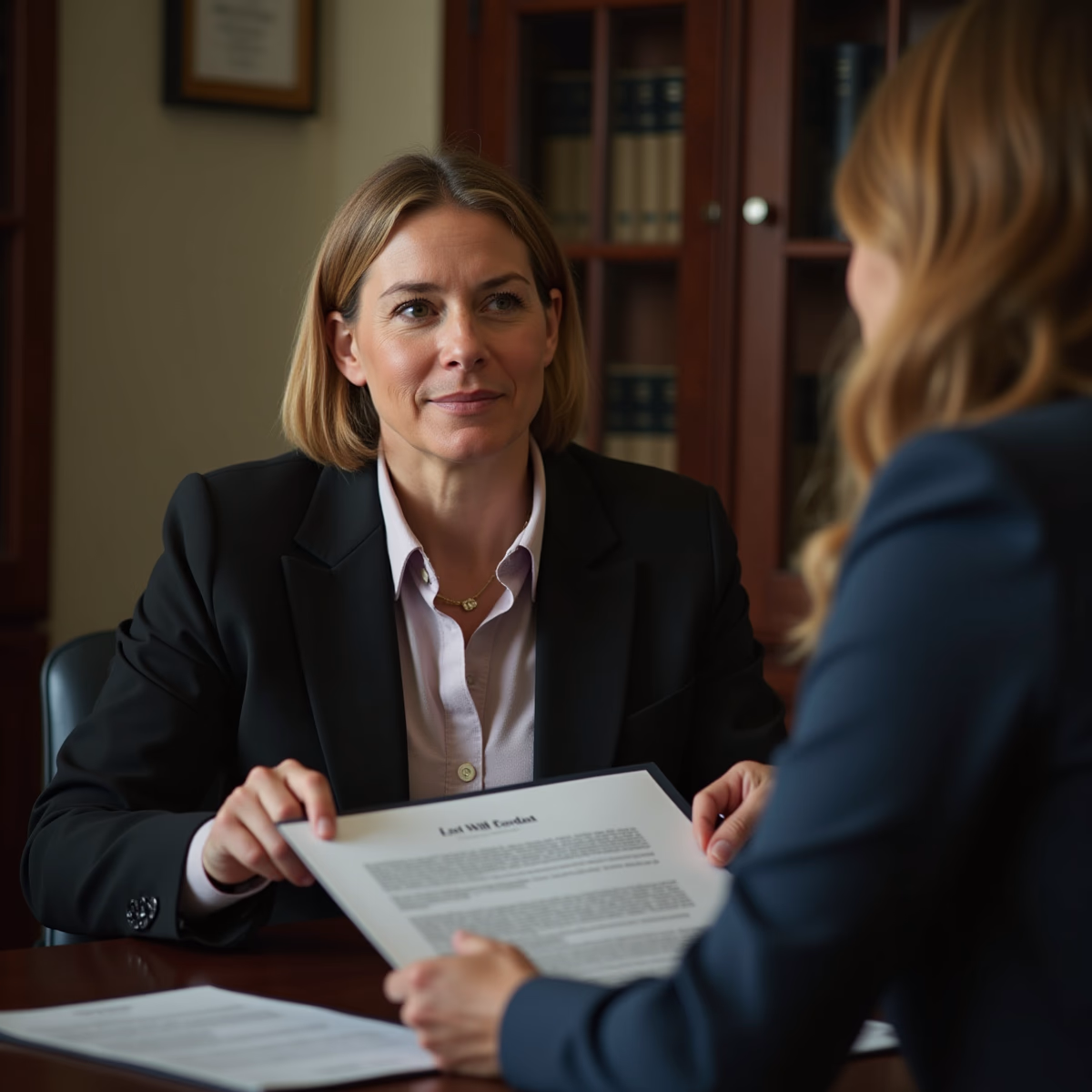
When a will is deemed invalid—due to improper witnessing, lack of testamentary capacity, or undue influence—California law dictates that the estate passes according to the laws of intestate succession. This means property is distributed based on a statutory formula, prioritizing spouses, children, and other relatives. This isn’t necessarily bad, but it often deviates from what the decedent truly intended, and bypasses any careful estate planning they undertook. Furthermore, it automatically triggers probate court administration, which is time-consuming, public, and expensive.
Can I transfer assets directly to my spouse to avoid probate?
Absolutely. Many couples want to simplify things and ensure their spouse inherits everything without court intervention. The Spousal Property Petition (Probate Code § 13650) is a powerful tool. It allows for the transfer of unlimited assets to a surviving spouse without full probate administration, regardless of the estate’s value. It is strictly for assets passing to a spouse/domestic partner and requires the property be characterized as community property or quasi-community property. Proper titling – ensuring assets are held as joint tenants with right of survivorship or are clearly identified as community property – is critical for this to work. We address this upfront with every client, reviewing all ownership structures.
What about real estate? Are there ways to avoid probate with a house?
There are several avenues. Under AB 2016 (Probate Code § 13151), a primary residence valued up to $750,000 qualifies for a ‘Petition for Succession’ rather than full probate administration. This is a court-filed petition requiring a hearing and a Judge’s Order, though it is significantly faster than full probate. Alternatively, the Affidavit for Real Property of Small Value offers a simpler process for less valuable properties. You can also use a Revocable Transfer on Death Deed, but remember it MUST be recorded within 60 days of notarization to be valid. Beneficiaries assume liability for the decedent’s debts up to the value of the property for 3 years after death.
What if I have a trust? Is probate completely avoided?
A properly funded trust is the gold standard for avoiding probate. However, even the most diligent individuals sometimes make mistakes. Often, we encounter assets accidentally left outside the trust. If a decedent intended an asset to be in their trust (e.g., listed on Schedule A) but failed to retitle it, a Section 850 Petition (Probate Code § 850) can obtain a court order confirming the asset as trust property. This ‘cures’ the title defect and avoids a full probate estate for that single asset. It’s a relatively inexpensive fix, but prevention—meticulous asset titling—is always preferable.
Are there options for smaller estates?
Yes. For deaths occurring on or after April 1, 2025, the gross value threshold for using a Small Estate Affidavit (Probate Code § 13100) has increased to $208,850. This procedure allows successors to collect personal property without court involvement. However, this total MUST NOT include assets held in joint tenancy, trust, or those with named beneficiaries (POD/TOD), but MUST include the value of any real property unless that property is handled via a separate summary procedure. For real property interests valued at less than $69,625 (the 2025/2026 adjusted limit), successors can file an Affidavit for Real Property of Small Value (Probate Code § 13200) with the Court Clerk and record a certified copy with the County Recorder, completely bypassing the need for a hearing.
What about vehicles and other personal property?
Transferring ownership of vehicles and vessels can also be streamlined. Vehicles and vessels may be transferred outside of probate using the Affidavit for Transfer Without Probate (DMV Form REG 5). The value of the vehicle is excluded from the $208,850 small estate calculation, meaning a high-value car does not disqualify an estate from using summary procedures.
As an Estate Planning Attorney and CPA with over 35 years of experience, I’ve seen firsthand the benefits of proactive estate planning. My CPA background gives me a unique perspective; understanding the step-up in basis for inherited assets, potential capital gains implications, and proper valuation is crucial for minimizing tax burdens for your heirs. It’s not just about avoiding probate, it’s about maximizing what’s left after probate is avoided.
What separates an efficient California probate process from a drawn-out conflict over authority and assets?
The path through California probate is rarely a straight line; it requires precise adherence to statutory deadlines, accurate asset characterization, and strict fiduciary compliance. Without a clear roadmap, what begins as a standard administrative proceeding can quickly dissolve into a costly battle over interpretation, valuation, and beneficiary rights.
| Duty | Compliance Check |
|---|---|
| Fiduciary Role | Review executor and administrator duties. |
| Negligence | Avoid fiduciary misconduct. |
| Protections | Understand beneficiary rights. |
Ultimately, the difference between a routine distribution and a protracted legal battle often comes down to preparation. By anticipating the demands of the Probate Code and addressing potential friction points with beneficiaries and creditors upfront, fiduciaries can navigate the system with greater confidence and lower liability.
Verified Authority on California Probate Alternatives
-
Personal Property Affidavit ($208,850 Limit): California Probate Code § 13100 (Small Estate Affidavit)
For deaths on or after April 1, 2025, the gross value threshold for using a Small Estate Affidavit has increased to $208,850. This procedure allows successors to collect cash, stocks, and personal items without court involvement. Warning: This total MUST NOT include assets held in joint tenancy, trust, or those with named beneficiaries (POD/TOD), but MUST include the value of real property unless handled via a separate summary procedure. -
Primary Residence Succession (AB 2016): California Probate Code § 13151 (Petition for Succession)
You must distinguish between the Affidavit for Real Property of Small Value (strictly for property <$69,625) and AB 2016. Under AB 2016, a primary residence valued up to $750,000 qualifies for a ‘Petition for Succession’ rather than full probate. This is a court-filed Petition requiring a Judge’s Order, though it is significantly faster than full administration. -
Spousal Property Petition (Unlimited): California Probate Code § 13650 (Spousal Transfers)
This powerful alternative allows for the transfer of unlimited assets to a surviving spouse or domestic partner without full probate administration, regardless of the estate’s value. It is strictly for assets passing to a spouse and requires the property be characterized as community property or quasi-community property. -
Trust Assets & The “Heggstad” Petition: California Probate Code § 850 (Heggstad Petition)
If a decedent intended an asset to be in their trust (e.g., listed on Schedule A) but failed to retitle it (the “Oops” factor), a Section 850 Petition can obtain a court order confirming the asset as trust property. This “cures” the title defect and avoids opening a full probate estate for that single asset. -
Vacant Land & Timeshares: California Probate Code § 13200 (Real Property of Small Value)
For real property interests valued at less than $69,625 (the 2025/2026 adjusted limit), successors can file an Affidavit for Real Property of Small Value with the Court Clerk and record a certified copy with the County Recorder. This completely bypasses the need for a hearing or judge’s order. -
Vehicle & Vessel Transfers (DMV): DMV Form REG 5 (Affidavit for Transfer Without Probate)
Vehicles and vessels may be transferred outside of probate using the Affidavit for Transfer Without Probate (REG 5). Critically, the value of the vehicle is excluded from the $208,850 small estate calculation, meaning a high-value car does not disqualify an estate from using summary procedures. -
Digital Asset Access (RUFADAA): California Probate Code § 870 (RUFADAA)
Even in summary administration, digital assets can be locked. Without specific RUFADAA language (Probate Code § 870) in your Will or Trust, service providers like Coinbase and Google can legally deny successors access to digital wallets and accounts, forcing a full probate just to retrieve them.
|
Attorney Advertising, Legal Disclosure & Authorship
ATTORNEY ADVERTISING.
This content is provided for general informational and educational purposes only and does not constitute legal, financial, or tax advice. Under the California Rules of Professional Conduct and State Bar advertising regulations, this material may be considered attorney advertising. Reading this content does not create an attorney-client relationship or any professional advisory relationship. Laws vary by jurisdiction and are subject to change, including recent 2026 developments under California’s AB 2016 and evolving federal estate and reporting requirements. You should consult a qualified attorney or advisor regarding your specific circumstances before taking action.
Responsible Attorney:
Steven F. Bliss, California Attorney (Bar No. 147856).
Local Office:
Escondido Probate Law720 N Broadway 107 Escondido, CA 92025 (760) 884-4044
Escondido Probate Law is a practice location and trade name used by Steven F. Bliss, Esq., a California-licensed attorney.
About the Author & Legal Review Process
This article was researched and drafted by the Legal Editorial Team of the Law Firm of Steven F. Bliss, Esq.,
a collective of attorneys, legal writers, and paralegals dedicated to translating complex legal concepts into clear, accurate guidance.
Legal Review:
This content was reviewed and approved by Steven F. Bliss, a California-licensed attorney (Bar No. 147856). Mr. Bliss concentrates his practice in estate planning and estate administration, advising clients on proactive planning strategies and representing fiduciaries in probate and trust administration proceedings when formal court involvement becomes necessary.
With more than 35 years of experience in California estate planning and estate administration,
Mr. Bliss focuses on structuring enforceable estate plans, guiding fiduciaries through court-supervised proceedings, resolving creditor and notice issues, and coordinating asset management to support compliant, timely distributions and reduce fiduciary risk. |