|
Legal & Tax Disclosure
ATTORNEY ADVERTISING.
This article is provided for general informational purposes only and does not constitute legal, financial, or tax advice. Reading this content does not create an attorney-client or professional advisory relationship. Laws vary by jurisdiction and are subject to change. You should consult a qualified professional regarding your specific circumstances. |
Emily just lost everything. After her mother passed, she discovered a handwritten will tucked inside an old photo album. It seemed valid – signed and dated – but because it didn’t meet the strict requirements of a formal, witnessed Will, the court rejected it. Now, after years of family harmony, Emily and her siblings are locked in a probate battle that will cost them tens of thousands in legal fees and irrevocably damage their relationships. This could have been avoided with even a basic, properly executed estate plan.
As an Estate Planning Attorney and CPA with over 35 years of experience here in Escondido, I’ve seen countless situations like Emily’s. While the idea of a “holographic will” – a will entirely handwritten by the testator – seems romantic and simple, California law surrounding them is surprisingly rigid and fraught with potential pitfalls. Let’s break down what’s required for a handwritten Will to be valid, and what you need to know to protect your estate.
What are the Requirements for a Valid Holographic Will?
A holographic will is permissible under California law (Probate Code § 6111), but it’s not a free pass to bypass standard Will formalities. The requirements are incredibly strict. It must be entirely handwritten – no pre-printed forms or typed portions are allowed. Every single part of the document, including all declarations and signing, must be in the testator’s own handwriting. Even a single printed word can invalidate the entire Will.
The Will must also clearly express testamentary intent. This means it must be evident from the document that the author intends it to be a distribution of their property upon death. A grocery list with a signature at the bottom, even if handwritten, isn’t a Will. The document must clearly state who receives what assets, or at least demonstrate a clear plan for the disposition of your property.
What Happens if My Handwritten Will Doesn’t Meet the Requirements?
If a Will is invalidated, assets fall under intestacy; however, for deaths on or after April 1, 2025, estates with personal property under $208,850 (per CPC § 13100) may still bypass full probate via affidavit. But that doesn’t mean it’s a desirable outcome. Intestacy laws dictate that property passes according to a pre-determined formula, which may not align with your wishes. This can lead to unintended consequences, family disputes, and significant delays in asset distribution.
The courts scrutinize holographic wills more carefully than typed, witnessed wills. This is because the lack of attestation – witnesses verifying the testator’s signature and mental capacity – places a heavier burden on the proponent of the Will to prove its validity.
What About Mistakes in My Handwritten Will?
Even if your holographic will initially appears valid, small errors can create big problems. Probate Code § 6110(c)(2) allows the court to validate a signature-defective Will if there is “clear and convincing evidence” of the testator’s intent; however, this requires a costly court petition and is not a guaranteed safety net. A misplaced date, an illegible signature, or ambiguous language can all be grounds for a challenge.
A common mistake I see is ambiguity in beneficiary designations. Using nicknames or vague descriptions (“my favorite niece”) can lead to disputes and require court interpretation. It’s crucial to be precise and identify beneficiaries by their full legal names.
How Does a Self-Proving Affidavit Affect a Holographic Will?
Unlike a traditional Will, a holographic will cannot be self-proved. Probate Code § 8220 specifies that a self-proving affidavit – a sworn statement by the witnesses attesting to the Will’s validity – applies only to wills signed with witnesses. This means the court will likely require testimony from individuals who can verify your handwriting and mental state at the time the Will was created, adding further complexity and expense to the probate process.
Why Your CPA Advantage Matters: Beyond Just Tax Filing
As a CPA as well as an attorney, I bring a unique perspective to estate planning. While I can help you draft a valid Will, I also understand the crucial tax implications of your estate. Proper estate planning can minimize capital gains taxes and maximize the step-up in basis for inherited assets, potentially saving your heirs a significant amount of money. A simple Will may address asset distribution, but it won’t necessarily address the complex valuation and tax considerations that are often involved.
What About Digital Assets and My Handwritten Will?
Don’t forget about your digital life. RUFADAA 2.0 (SB 1458), effective 2025, California law (CPC § 871) was expanded to grant fiduciaries power over digital accounts; however, you must still grant explicit RUFADAA powers in your Will or Trust to bypass federal privacy blocks. A handwritten Will likely won’t adequately address access to your online accounts, social media profiles, and cryptocurrency wallets, leaving a significant administrative burden on your loved ones.
Are There Alternatives to a Handwritten Will?
While a holographic will is permissible, I strongly advise against relying on it as your primary estate planning tool. A formally drafted and witnessed Will offers far greater legal security and peace of mind. Even a simple Will, prepared with the assistance of an attorney, can prevent many of the pitfalls associated with holographic wills.
Furthermore, consider a Trust-based estate plan. Trusts offer greater flexibility, privacy, and control over your assets, and can help you avoid probate altogether.
Understanding this specific rule is helpful, but it is ultimately the strength of your underlying Will that protects your legacy.
In my Escondido practice, I frequently see “perfect” asset plans unravel because the base estate documents could not survive a court challenge.
Here is how California courts evaluate the true intent and validity of your estate documents:
What standards do California judges use to determine a will’s true meaning?
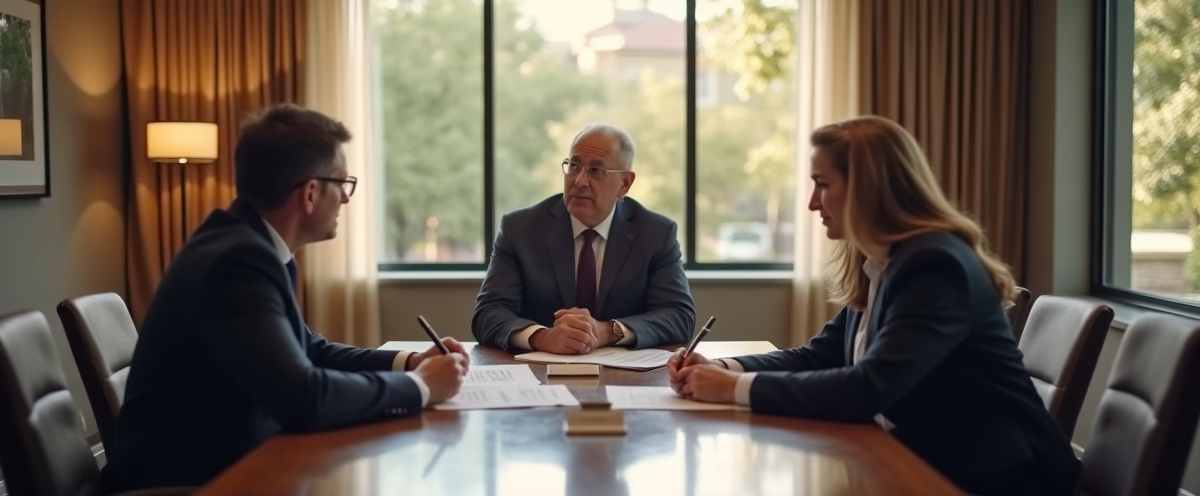
In California, a last will and testament is reviewed under probate standards that focus on intent, capacity, and execution. Clear drafting reduces ambiguity, limits misinterpretation, and helps families avoid unnecessary conflict during estate administration.
To ensure the will functions as intended, the executor must understand their fiduciary obligations, while the family should be prepared for the probate process required to enforce the document.
When a will is drafted with California probate review in mind, it becomes a stabilizing roadmap rather than a source of conflict. Clear intent, proper authority, and compliant execution protect both families and estates.
Resources for Legal Standards & Probate Procedure
-
Escondido Local Rules: San Diego Superior Court – Probate Division
Access the essential “Local Rules” (Division IV) effective January 1, 2026. This includes mandatory e-filing procedures, current Probate Examiner notes, and Local Rule 4.4.5 regarding remote appearance requirements (via MS Teams) for non-evidentiary hearings. -
Attorney Verification: State Bar of California
The official regulatory body for California attorneys. Use this to verify a lawyer’s “Certified Specialist” status in Estate Planning or to access 2026 guidelines on the ethical handling of Client Trust Accounts (IOLTA). -
Self-Help & Forms: California Courts – Wills, Estates, and Probate
The Judicial Council’s official portal. It includes the updated 2026 forms for the $208,850 personal property threshold and the $750,000 “Primary Residence” simplified transfer procedure (AB 2016). -
Federal Estate Tax: IRS Estate Tax Guidelines
The authoritative federal resource for estate and gift tax filing. It reflects the 2026 “OBBBA” permanent exemption of $15 million per individual, replacing the previously scheduled Tax Cuts and Jobs Act (TCJA) sunset.
|
Attorney Advertising, Legal Disclosure & Authorship
ATTORNEY ADVERTISING.
This content is provided for general informational and educational purposes only and does not constitute legal, financial, or tax advice. Under the California Rules of Professional Conduct and State Bar advertising regulations, this material may be considered attorney advertising. Reading this content does not create an attorney-client relationship or any professional advisory relationship. Laws vary by jurisdiction and are subject to change, including recent 2026 developments under California’s AB 2016 and evolving federal estate and reporting requirements. You should consult a qualified attorney or advisor regarding your specific circumstances before taking action.
Responsible Attorney:
Steven F. Bliss, California Attorney (Bar No. 147856).
Local Office:
Escondido Probate Law720 N Broadway 107 Escondido, CA 92025 (760) 884-4044
Escondido Probate Law is a practice location and trade name used by Steven F. Bliss, Esq., a California-licensed attorney.
About the Author & Legal Review Process
This article was researched and drafted by the Legal Editorial Team of the Law Firm of Steven F. Bliss, Esq.,
a collective of attorneys, legal writers, and paralegals dedicated to translating complex legal concepts into clear, accurate guidance.
Legal Review:
This content was reviewed and approved by Steven F. Bliss, a California-licensed attorney (Bar No. 147856). Mr. Bliss concentrates his practice in estate planning and estate administration, advising clients on proactive planning strategies and representing fiduciaries in probate and trust administration proceedings when formal court involvement becomes necessary.
With more than 35 years of experience in California estate planning and estate administration,
Mr. Bliss focuses on structuring enforceable estate plans, guiding fiduciaries through court-supervised proceedings, resolving creditor and notice issues, and coordinating asset management to support compliant, timely distributions and reduce fiduciary risk. |