
Legal & Tax Disclosure
ATTORNEY ADVERTISING & LEGAL DISCLOSURE:
This article is for informational purposes only and does not constitute legal, financial, or tax advice. Reading this content does not form an attorney-client or CPA-client relationship. Probate and tax laws are complex and subject to change—including recent 2026 shifts under California’s AB 2016 and federal OBBBA reporting requirements. You should consult with a qualified professional regarding your specific circumstances before taking action.
Responsible Attorney: Steven Farley Bliss, a California-licensed attorney (Bar 147856) with a bona fide office in Escondido, San Diego County, California.
I had a client, Jordan, recently come to me after attempting to probate her mother’s will herself. She’d filed the Petition for Probate (Form DE-120) correctly, and the court issued a summons. But she’d neglected to properly complete and mail the Notice of Petition to Administer Estate (Form DE-121) to all the legal heirs. It was a costly mistake. After months of work, the entire process had to be restarted, and she incurred significant additional legal fees to correct the defect.
The difference between the DE-120 and DE-121 forms is fundamental. The DE-120 is the initial pleading that asks the court to open the probate case and appoint an executor or administrator. It’s the document that gets the ball rolling. The DE-121, however, is the critical notification to all interested parties—the heirs, beneficiaries, and potential creditors—that the case has been opened and that they have a limited time to object or file claims. They are completely different, serving separate purposes and triggering different requirements.
Think of it this way: the DE-120 is the ‘invitation’ to the probate party, and the DE-121 is the individual RSVP cards that must be sent to everyone who should be attending. Failing to send enough cards – or sending them late – means the party isn’t legally valid.
What Happens if I Mix Up DE-120 and DE-121?
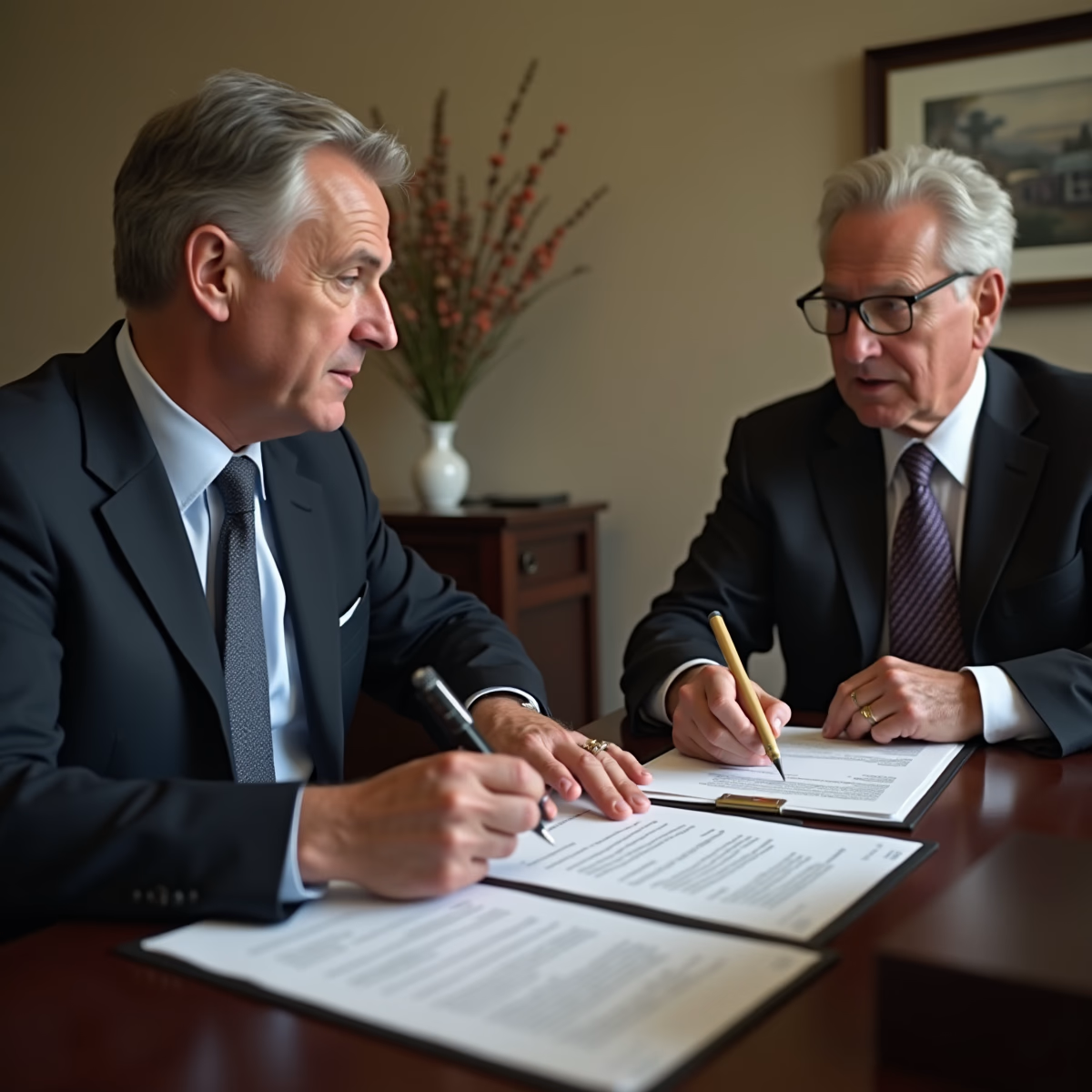
Mixing up these forms or failing to understand their distinct requirements can lead to severe consequences. A judge cannot grant your petition if proper notice hasn’t been given. This means the court will continue the hearing, forcing you to redo the entire notice process—resubmitting the DE-121, potentially re-publishing the notice in the newspaper, and incurring additional costs and delays. This is why meticulous attention to detail is essential when dealing with probate matters.
Why is the DE-121 So Important?
The DE-121 isn’t just a formality; it’s the cornerstone of due process in probate proceedings. It ensures that everyone with a legitimate interest in the estate receives proper notice of the case, giving them the opportunity to protect their rights. Over the course of my 25 years practicing probate law, I’ve seen countless cases derailed by simple notice errors. It’s always better to err on the side of caution and ensure that every required party receives timely and accurate notification. As a CPA as well, I often find the issues with notice become tax related when parties aren’t made aware of potential estate tax liabilities.
Verified Authority on Probate Notice Requirements
-
Mailing Requirements (The 15-Day Rule): California Probate Code § 8110
Jurisdiction is everything. At least 15 days before the hearing on the petition, you must mail the Notice of Petition to Administer Estate (Form DE-121) to every person named in the will and every legal heir. If you miss an heir, the court lacks the authority to act. -
Publication Mandate: California Probate Code § 8120 (Newspaper of General Circulation)
You cannot hide a probate case. The law requires publication in a newspaper circulated in the area where the decedent lived. This publication must run three times before the hearing. The court will check for the “Proof of Publication” affidavit from the newspaper before granting the petition. -
Notice to Attorney General: California Probate Code § 8111 (Charitable/No Heirs)
If the will leaves assets to a specific charity or a charitable trust, or if the decedent has no known heirs, the California Attorney General becomes a mandatory party to the case. Failing to notice the AG will result in the court continuing your hearing. -
Foreign Citizen Notice: California Probate Code § 8113
If the decedent was a citizen of a foreign nation, or if a beneficiary is a foreign resident, California law often requires notice be sent to the Consulate of that country. This ensures international treaties regarding property rights are respected. -
Request for Special Notice: California Probate Code § 1250
This is a strategic tool for beneficiaries and creditors. By filing Form DE-154, you force the executor to send you a copy of every major document filed in the case (Inventories, Accountings, Petitions). It is the best way to monitor an estate without constantly checking the court docket. -
Defective Notice Consequences: California Probate Code § 8124
This code section is the “stop sign.” If the publication or mailing requirements are not met perfectly, the court cannot hear the petition. The judge has no discretion to waive the notice defect; the hearing must be continued, and notice must be redone properly.
What determines whether a California probate estate closes smoothly or turns into litigation?
The path through California probate is rarely a straight line; it requires precise adherence to statutory deadlines, accurate asset characterization, and strict fiduciary compliance. Without a clear roadmap, what begins as a standard administrative proceeding can quickly dissolve into a costly battle over interpretation, valuation, and beneficiary rights.
| Financial Issue | Process Step |
|---|---|
| Bills | Manage estate creditor process. |
| Challenges | Handle disputed creditor claims. |
| Expenses | Track fees and costs. |
A stable probate administration outcome usually follows from clarity, consistency, and readiness for court review, especially when multiple stakeholders and competing interpretations are involved. When documentation supports enforcement and timelines are respected, families are less likely to face preventable escalation.
Legal & Tax Disclosure
ATTORNEY ADVERTISING & LEGAL DISCLOSURE:
This article is for informational purposes only and does not constitute legal, financial, or tax advice. Reading this content does not form an attorney-client or CPA-client relationship. Probate and tax laws are complex and subject to change—including recent 2026 shifts under California’s AB 2016 and federal OBBBA reporting requirements. You should consult with a qualified professional regarding your specific circumstances before taking action.
Responsible Attorney: Steven Farley Bliss, a California-licensed attorney (Bar 147856) with a bona fide office in Escondido, San Diego County, California.
About the Author & Legal Review Process
This article was researched and drafted by the The Law Firm of Steven F. Bliss Esq.’s Legal Editorial Team, a collective of experienced Attorneys, legal writers, and paralegals dedicated to making complex law accessible.
Legal Review: To ensure the highest level of accuracy and strategic insight, this content was rigorously reviewed and approved by Steven Farley Bliss. With over 32 years of experience in Estate Planning & Probate, Mr. Bliss ensures that all information meets the firm’s strict standards for legal precision and current case law compliance.
With more than 32 years of experience in California Probate and Estate Administration, Mr. Bliss focuses on guiding executors through the complex court system, resolving creditor disputes, and managing estate assets to ensure a smooth distribution process that minimizes delay and protects the executor from liability.
Visit our Escondido Law office:
Address:
Escondido Probate Law720 N Broadway 107
Escondido, CA 92025
(760) 884-4044